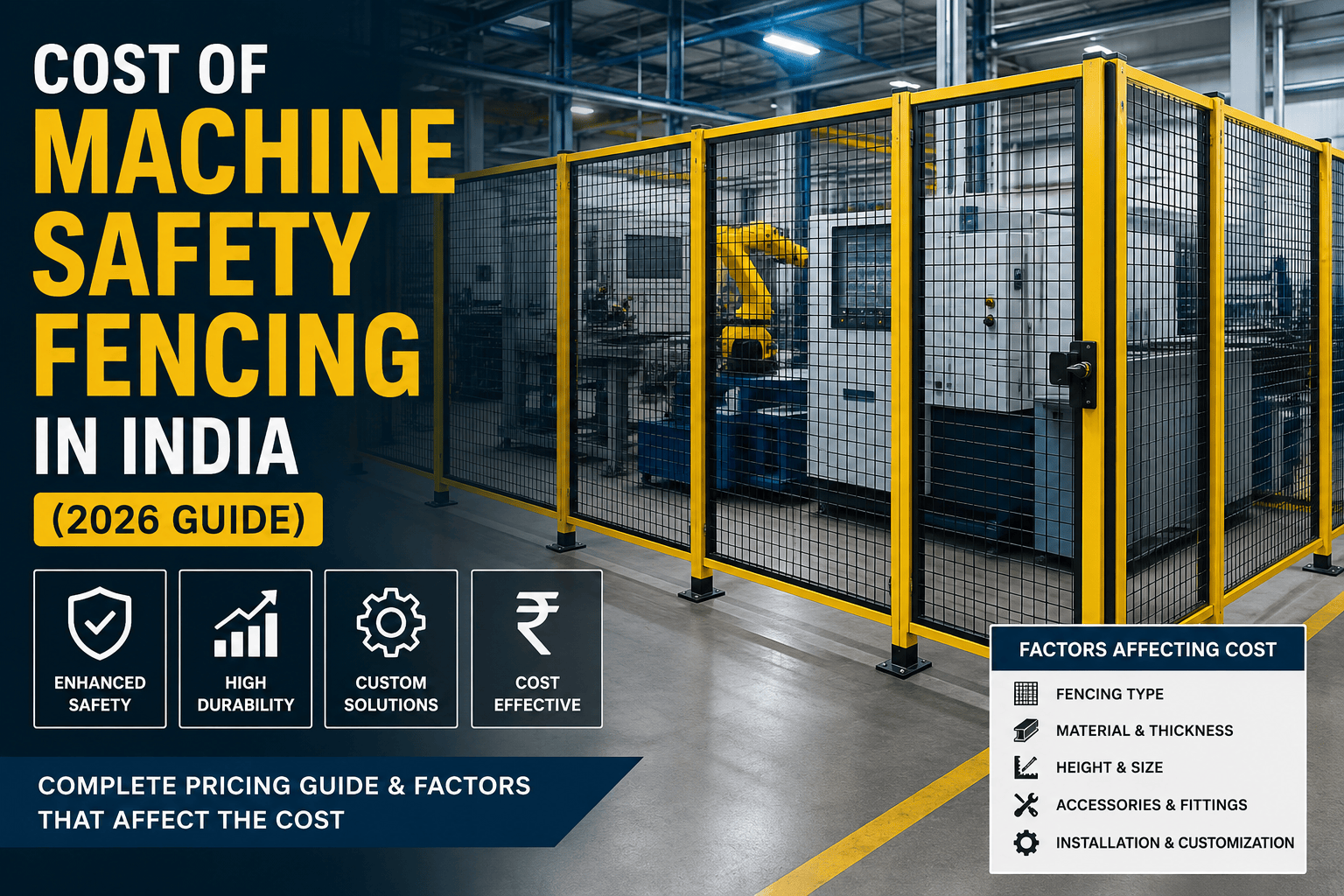
One of the most common questions plant managers, safety officers, and procurement heads across Pune's MIDC zones ask us is: "How much does machine safety fencing cost in India?" It is a straightforward question, but the honest answer requires context. The cost of industrial machine safety fencing in India varies significantly based on fence type, panel height, infill material, access door configuration, surface finish, interlock integration, project scale, and site conditions. This 2026 guide breaks down every cost driver so you can budget accurately, compare quotes intelligently, and make a procurement decision that delivers long-term value rather than the lowest upfront number.
Devidatt Enterprises is a leading machine guarding manufacturer based in Dhankawadi, Pune, with over a decade of experience supplying and installing safety fencing across Maharashtra's largest MIDC industrial clusters. The pricing insights in this guide reflect real project data from our installations across Chakan, Bhosari, Ranjangaon, Talegaon, and Hadapsar MIDC throughout 2025 and into 2026.
Why Machine Safety Fencing Costs Vary So Much in India
Before presenting numbers, it is essential to understand why two quotes for "machine safety fencing" can differ by 40 to 60 percent from different vendors even for what appears to be the same job. The Indian market for industrial safety barriers spans a wide quality and compliance spectrum — from lightweight, non-structural painted angle-iron barriers to genuinely engineered, ISO-compliant modular guarding systems with interlocked access control. These are fundamentally different products even if both are colloquially called "safety fencing."
The five primary variables that drive cost are: structural frame material and wall thickness, infill panel type (weld mesh versus polycarbonate versus expanded metal), fence height, access door specification and interlock type, and surface treatment (powder coating versus hot-dip galvanizing versus epoxy). Understanding these variables allows you to make like-for-like comparisons when evaluating quotes from multiple manufacturers.
Machine Safety Fencing Price Ranges in India (2026)
The following price ranges represent supply-only costs (excluding installation, civil works, and interlock wiring) for manufactured safety fencing systems delivered within Maharashtra. Prices are indicative for planning purposes; actual quotes depend on quantity, configuration complexity, and current steel input costs.
| Fencing Type | Height | Approx. Cost per Running Metre (Supply Only) | Best Suited For |
|---|---|---|---|
| Standard Modular Weld Mesh Panel System | 1400mm | ₹2,800 – ₹3,800 | General machine perimeters, CNC area guarding |
| Standard Modular Weld Mesh Panel System | 1800mm | ₹3,500 – ₹4,800 | Higher-risk machinery, stamping press areas |
| Polycarbonate Infill Panel System | 1600mm | ₹5,500 – ₹7,500 | Areas requiring full visibility, electronics manufacturing |
| Heavy-Duty Robot Cell Perimeter Fencing | 2000mm | ₹5,000 – ₹7,000 | Robotic welding cells, high-inertia robot arms |
| Expanded Metal Infill System | 1800mm | ₹4,200 – ₹5,800 | Dusty environments, foundries, casting areas |
| Hot-Dip Galvanized Outdoor System | 1800mm | ₹5,800 – ₹8,000 | Outdoor MIDC compound guarding, corrosive environments |
| Stainless Steel Hygienic Finish System | 1600mm | ₹12,000 – ₹18,000 | Pharma, food processing, clean room adjacent areas |
Note: All prices above are indicative 2026 rates for Maharashtra/Pune region supply. Prices are subject to change based on MS steel input costs, which fluctuate with global steel markets. Contact Devidatt Enterprises at +91 8975383232 for a firm project-specific quotation.
Access Door Cost: A Significant Budget Line Item
Access doors are consistently underestimated in initial budgets. A basic single-leaf hinged access door with a mechanical slam-action latch costs significantly less than a safety-interlocked door with a coded safety switch. However, for any machine guarding installation that is intended to meet Factories Act compliance and pass OEM safety audits, a simple latch is rarely sufficient — and specifying the wrong door type can mean the entire installation fails its audit regardless of how well the perimeter fencing is built.
| Access Door Type | Approx. Unit Cost (Supply Only) | Compliance Use Case |
|---|---|---|
| Single-leaf door, mechanical latch (no interlock) | ₹8,000 – ₹12,000 | Low-risk, non-automated machinery areas |
| Single-leaf door with mechanical safety switch | ₹14,000 – ₹20,000 | Standard CNC, press, conveyor guarding |
| Single-leaf door with magnetic coded safety switch | ₹22,000 – ₹32,000 | Robot cells, high-risk automated machinery |
| Double-leaf door with solenoid lock (escape-release) | ₹35,000 – ₹55,000 | Large robot cells, automated lines with personnel entry |
| RFID / access-controlled interlocked door | ₹45,000 – ₹75,000 | High-security cells, authorised personnel only |
Installation Cost: What to Budget Beyond Supply
Supply cost is only part of the total investment. Installation charges for machine safety fencing in India depend on project complexity, floor conditions, travel distance from the manufacturing base, and whether civil works (anchor bolt drilling, floor grinding, levelling) are required. As a general planning guide, installation typically adds 18 to 30 percent to the total supply cost for straightforward projects, and up to 40 percent for complex installations involving difficult floor surfaces, restricted access, or simultaneous interlock wiring commissioning.
| Installation Cost Component | Typical Range (2026, Pune / Maharashtra) |
|---|---|
| Panel erection and post anchoring (labour) | ₹350 – ₹650 per running metre |
| Floor drilling and anchor bolt installation | ₹120 – ₹250 per anchor point |
| Access door hanging and alignment | ₹1,500 – ₹3,500 per door |
| Safety switch wiring (basic interlock to E-stop) | ₹3,500 – ₹8,000 per switch point |
| Safety relay / safety PLC integration | ₹12,000 – ₹35,000 per zone |
| Site survey, design, and compliance documentation | ₹8,000 – ₹25,000 (project scope dependent) |
Real Project Cost Examples: Pune MIDC Machine Safety Fencing
Abstract per-metre rates are useful for budgeting, but seeing how costs accumulate across realistic project scenarios helps plant managers and procurement teams build more accurate capital expenditure forecasts. The following representative project scenarios are based on typical installations carried out by Devidatt Enterprises across Pune's industrial zones.
Scenario 1: Single CNC Machining Centre Perimeter Guard — Bhosari MIDC
A precision engineering unit in Bhosari required perimeter guarding for a single 5-axis CNC machining centre with a floor footprint of approximately 4 metres × 3 metres. The installation used standard 1600mm weld mesh panels with a single interlocked access door fitted with a mechanical safety switch. Total perimeter: approximately 18 running metres.
- Supply (panels + posts + 1 access door with switch): ₹82,000 – ₹98,000
- Installation (erection, anchoring, switch wiring): ₹18,000 – ₹24,000
- Total Project Estimate: ₹1,00,000 – ₹1,22,000
Scenario 2: Robotic Welding Cell — Chakan MIDC Automotive Tier-1
An automotive component supplier in Chakan required robot cell safety fencing for a 6-axis welding robot with a 1.8m reach radius. The cell perimeter measured 28 running metres at 2000mm height with heavy-duty panels, two interlocked double-leaf access doors with solenoid locks, and integration to the robot controller safety I/O circuit.
- Supply (heavy-duty panels + 2 double-leaf solenoid doors): ₹2,40,000 – ₹2,90,000
- Installation (erection, wiring, robot I/O integration, commissioning): ₹65,000 – ₹90,000
- Total Project Estimate: ₹3,05,000 – ₹3,80,000
Scenario 3: Automated Production Line Perimeter — Ranjangaon MIDC
A multinational consumer goods manufacturer in Ranjangaon commissioned full perimeter fencing for a 60-metre automated assembly and packaging line with 6 interlocked access doors at designated operator stations and 4 material infeed/outfeed pass-through openings with light curtain integration points.
- Supply (180 running metres, 6 access doors, pass-through frames): ₹8,80,000 – ₹11,00,000
- Installation (erection, all wiring, light curtain mounting, documentation): ₹2,20,000 – ₹3,20,000
- Total Project Estimate: ₹11,00,000 – ₹14,20,000
What Drives Cost Up: Premium Options Worth Considering
Not every cost increment is unnecessary spending. Several premium specifications deliver measurable returns in compliance, durability, or operational convenience that justify the higher investment over a 5 to 10 year asset life.
- Polycarbonate infill panels (vs. weld mesh): Add approximately 60 to 80 percent to panel supply cost but provide full visual transparency, enabling supervisors to monitor machine status without entering guarded zones and eliminating the need for separate vision windows. For quality-critical processes where visual monitoring is frequent, the operational benefit is significant.
- Hot-dip galvanizing (vs. powder coating): Adds 25 to 40 percent to surface treatment cost but delivers a 25 to 30 year corrosion life versus 8 to 12 years for standard powder coating. For factories in humid environments, near coolant mist, or in coastal MIDC zones, galvanizing provides far better lifecycle economics.
- Magnetic coded safety switches (vs. mechanical switches): Add 40 to 60 percent per door over mechanical switches but achieve higher Safety Integrity Level (SIL) ratings, making them the correct specification for robot cells and other high-hazard machinery where a mechanical switch's lower failure detection capability is insufficient for the risk level.
- Modular system (vs. fixed custom fabrication): Modular panel systems typically cost 10 to 20 percent more than equivalent fixed-weld custom barriers at initial installation. However, when machinery is relocated or the line is reconfigured — which happens routinely in MIDC facilities serving automotive OEMs with frequent model changeovers — the modular system can be dismantled and reinstalled without any additional fabrication cost, while a custom-welded barrier must be scrapped and rebuilt from zero.
What Drives Cost Down: Where You Can Save Without Compromising Safety
There are legitimate ways to optimize machine safety fencing budgets without sacrificing compliance quality or structural integrity. Understanding where specification decisions genuinely affect safety versus where they reflect over-engineering helps procurement teams make smarter choices.
- Standardize panel heights across the facility: Using a single fence height (for example, 1800mm throughout) rather than mixing 1400mm, 1600mm, and 1800mm panels allows bulk procurement of posts and panels, reducing per-unit costs by 12 to 18 percent on larger projects.
- Optimize access door count: Every additional interlocked access door adds ₹14,000 to ₹55,000 in supply cost plus wiring charges. A careful layout review often reveals that fewer, better-positioned access doors can serve the same operational access requirements with a lower total door count.
- Phased project execution: For large facilities, phasing the installation (highest-risk machines first, then medium-risk areas) allows the factory to spread capital expenditure across two or three financial years while achieving compliance on the highest-liability equipment first.
- Frame material selection for the actual risk level: 50×50×3mm square tube posts are appropriate for most standard machine guarding applications. Specifying 60×60×4mm posts throughout a facility where only a small number of high-inertia robot cells genuinely require them unnecessarily increases material cost across the whole project.
The Real Cost of NOT Installing Machine Safety Fencing
A cost analysis of machine safety fencing in India would be incomplete without examining the financial consequences of non-compliance and incidents. These costs are rarely factored into procurement decisions, yet they dwarf the investment in proper machine guarding by orders of magnitude.
Under the Factories Act 1948 and the Occupational Safety, Health and Working Conditions Code 2020, a factory owner or occupier found guilty of failing to guard machinery causing injury can face fines, prosecution, and factory licence suspension. Beyond statutory penalties, the direct and indirect costs of a single serious machine-related accident in a manufacturing facility include worker compensation payouts, legal fees, ESIC dispute costs, production downtime during investigation, loss of OEM supplier certification (often permanent), and reputational damage affecting future contract awards from quality-conscious automotive OEMs in Chakan and Talegaon who conduct annual supplier safety audits.
According to the National Safety Council of India (NSCI), machinery-related accidents account for a substantial share of manufacturing sector injuries annually. The compensation and legal costs from a single permanent disability case routinely exceed ₹15 to ₹40 lakhs when all direct and indirect costs are aggregated. A complete machine guarding installation for a medium-sized manufacturing cell costs a fraction of that figure.
ROI Calculation: Machine Safety Fencing Investment vs. Risk Cost
The following simplified ROI framework helps plant managers and safety officers build the business case for machine guarding investment when presenting to management or board level stakeholders.
| Cost Category | Without Machine Safety Fencing | With Devidatt Safety Fencing |
|---|---|---|
| Annual insurance premium (mid-size facility) | ₹4,50,000 – ₹6,00,000 | ₹3,20,000 – ₹4,20,000 (documented guarding discount) |
| Risk of machinery accident compensation | ₹15,00,000 – ₹40,00,000 per incident | Substantially reduced with proper guarding |
| OEM audit failures / lost contracts | High risk — disqualification common | Eliminated with certified installation |
| Regulatory fines / factory closure | ₹1,00,000 – ₹10,00,000+ per violation | Eliminated with Factories Act compliance |
| Machine guarding investment (amortized over 10 years) | Nil (deferred cost) | ₹15,000 – ₹40,000 per year per machine |
The arithmetic consistently shows that machine safety fencing pays for itself within 12 to 24 months when insurance premium savings and avoided accident risk costs are taken into account — before factoring in the value of OEM contract retention, which for MIDC-based tier suppliers can represent crores in annual revenue.
How to Get an Accurate Machine Safety Fencing Quote in India
The most common mistake in machine safety fencing procurement is requesting price-per-metre quotes without providing adequate project context. A ₹2,800-per-metre quote and a ₹5,500-per-metre quote may not be comparable at all — one may be for lightweight, non-interlocked angle iron barriers and the other for a fully specified, audit-grade modular system. To obtain accurate, comparable quotations from manufacturers, your RFQ should include the following information:
- Machine type and hazard category: Is this a CNC centre, stamping press, robotic cell, conveyor, or automated line? The machine type determines the required barrier performance specification.
- Required fence height: State the minimum height based on your risk assessment or the machine's maximum hazard height, not just a general preference.
- Total perimeter length: Measured running metres of fence required. Include corner posts and T-junction posts if the layout is non-rectangular.
- Number and type of access doors: Specify how many entry points are needed, the required door width (standard 900mm or wider for forklift/AGV access), and the required interlock type (mechanical switch, magnetic coded switch, or solenoid lock).
- Infill material preference: Weld mesh (economical, good ventilation), polycarbonate (maximum visibility), or expanded metal (impact resistance, tamper resistance).
- Surface finish: Standard powder coat (Safety Yellow RAL 1023), custom colour, hot-dip galvanizing, or stainless steel.
- Integration requirements: Does the safety interlock need to connect to a machine safety relay, PLC safety I/O, or robot controller safety circuit? If so, what control platform is in use?
- Timeline: Is this a planned capital expenditure or an urgent compliance requirement? Expedited fabrication and installation commands a premium.
Why Indian Manufacturers Should Avoid the Cheapest Fencing Quote
It bears stating directly: the lowest-cost machine safety fencing quote in the Indian market very frequently represents a non-compliant product. Unstructured mild steel barriers with thin-wall tubing, inadequate floor anchoring, no interlocked access control, and non-standard mesh sizes can be fabricated by local fabricators at very low cost — but they will not satisfy a factory inspector, pass an OEM supplier safety audit, or be recognized by an insurance assessor as compliant machine guarding. A facility that installs such barriers has spent money without achieving compliance, and will need to spend again on a proper installation when the compliance gap becomes unavoidable.
The correct approach is to invest in a properly engineered, compliant installation once — from an ISO-certified manufacturer with documented experience in the specific machine type being guarded — and treat that installation as a 10 to 15 year asset on the plant's books.
Devidatt Enterprises: Competitive, Transparent Pricing for Certified Safety Fencing
At Devidatt Enterprises, we provide detailed written quotations that itemise panel supply, post supply, access door and hardware supply, surface finish, installation labour, civil works, interlock wiring, commissioning, and compliance documentation as separate line items. This level of transparency allows you to understand exactly what you are buying, compare our quotation accurately against alternatives, and make value-based procurement decisions rather than cost-per-metre comparisons that obscure more than they reveal.
We serve clients across all major MIDC industrial zones in Pune, Nashik, and greater Maharashtra with supply-and-install capability, and offer site survey visits at no charge for qualifying projects. Our industrial machine safety fencing systems are manufactured at our Dhankawadi facility under ISO quality protocols, with full compliance documentation provided post-installation.
Get an Accurate 2026 Price Quotation for Your Facility
Contact Pune's leading machine safety fencing manufacturer for a transparent, itemised quotation tailored to your specific machines and MIDC facility layout.
Phone: +91 8975383232
Email: info@devidattenterprises.com
Website: www.devidattenterprises.com
Manufacturing Facility: H.No. 40/3 Pathar Bhag, Dhankawadi, Pune, Maharashtra 411046
Frequently Asked Questions: Machine Safety Fencing Cost in India
1. What is the average cost per metre of machine safety fencing in India in 2026?
For a standard modular weld mesh panel system at 1800mm height with powder coat finish — the most common specification for CNC machine guarding in Pune's MIDC facilities — supply cost runs approximately ₹3,500 to ₹4,800 per running metre in 2026. Adding installation labour and access doors typically brings the all-in project cost to ₹5,000 to ₹7,500 per running metre for a complete, compliant installation. Polycarbonate infill, heavy-duty robot cell specifications, and stainless steel finish systems command higher rates.
2. Is machine safety fencing a capital expenditure or operating expenditure in India?
Machine safety fencing installed as a fixed, permanent improvement to a factory building or as an integral component of a production line is typically treated as capital expenditure (capex) in Indian accounting practice, depreciable under the Plants and Machinery category as per the Companies Act 2013 depreciation schedule. Your finance team and statutory auditors should confirm the classification for your specific project. Some smaller, relocatable modular barriers may be treated as opex depending on the accounting policy.
3. Does GST apply to machine safety fencing in India?
Yes. Industrial machine safety fencing — including modular panel systems, posts, access doors, and associated hardware — attracts 18% GST as a fabricated steel product and industrial safety equipment in India. Installation services provided by the manufacturer also attract GST, typically at 18% for works contract services. Always verify the applicable GST rate with your manufacturer and CA at the time of procurement, as rate notifications can change.
4. How does quantity affect machine safety fencing pricing in India?
Quantity significantly affects per-unit pricing. A single machine guarding installation of 20 running metres will be priced at a higher per-metre rate than a facility-wide project of 300 running metres, due to economies of scale in steel procurement, fabrication setup, and installation mobilisation. For large projects above 150 running metres, it is common to negotiate 12 to 20 percent reductions on list prices. Multi-phase projects where the second and third phases are contractually committed at the time of the first phase quotation also attract better pricing from most manufacturers.
5. What is the lead time and does it affect cost?
Standard lead time for modular weld mesh panel systems from Devidatt Enterprises is 7 to 10 working days from confirmed purchase order. Custom-height panels, polycarbonate infill systems, and heavy-duty robot cell configurations require 14 to 21 working days. Expedited delivery within 3 to 5 working days is available for urgent compliance situations and typically commands a 15 to 25 percent premium on supply cost to cover priority scheduling and sub-component procurement.
6. Can I get financing or payment terms for large machine safety fencing projects?
Devidatt Enterprises offers phased payment terms for qualifying projects above ₹5,00,000 in project value, typically structured as advance against order, milestone payment at supply dispatch, and balance at installation completion and commissioning sign-off. For clients with existing banking relationships and credit facilities, purchase order financing through commercial banks is a common route for larger MIDC factory projects. Contact our sales team to discuss payment structures appropriate for your project scale.
7. Are there any government subsidies or schemes for industrial safety fencing investment in India?
Under various state government schemes in Maharashtra, eligible manufacturing MSMEs may access interest subsidy on capital loans for plant safety improvements, including machine guarding, under programmes administered through Maharashtra Industrial Development Corporation (MIDC) and the state's MSME development policies. The Ministry of Labour and Employment's National Safety Council also periodically offers awareness and compliance support programmes. We recommend consulting your MIDC liaison officer or a government scheme consultant to check current eligibility. The specifics of available schemes change with each state budget cycle.
Pricing information in this guide is indicative and based on 2026 market data for Maharashtra and the Pune MIDC region. Actual project costs depend on specification, site conditions, access, and prevailing steel input prices at the time of order. All projects should be quoted individually after site survey and specification review.
*This article is for informational and planning purposes. Machine guarding specification requirements must be determined through a qualified risk assessment conducted by a certified safety professional in accordance with applicable Indian and international safety standards. Pricing should be confirmed via formal quotation from Devidatt Enterprises before inclusion in capital budgets.