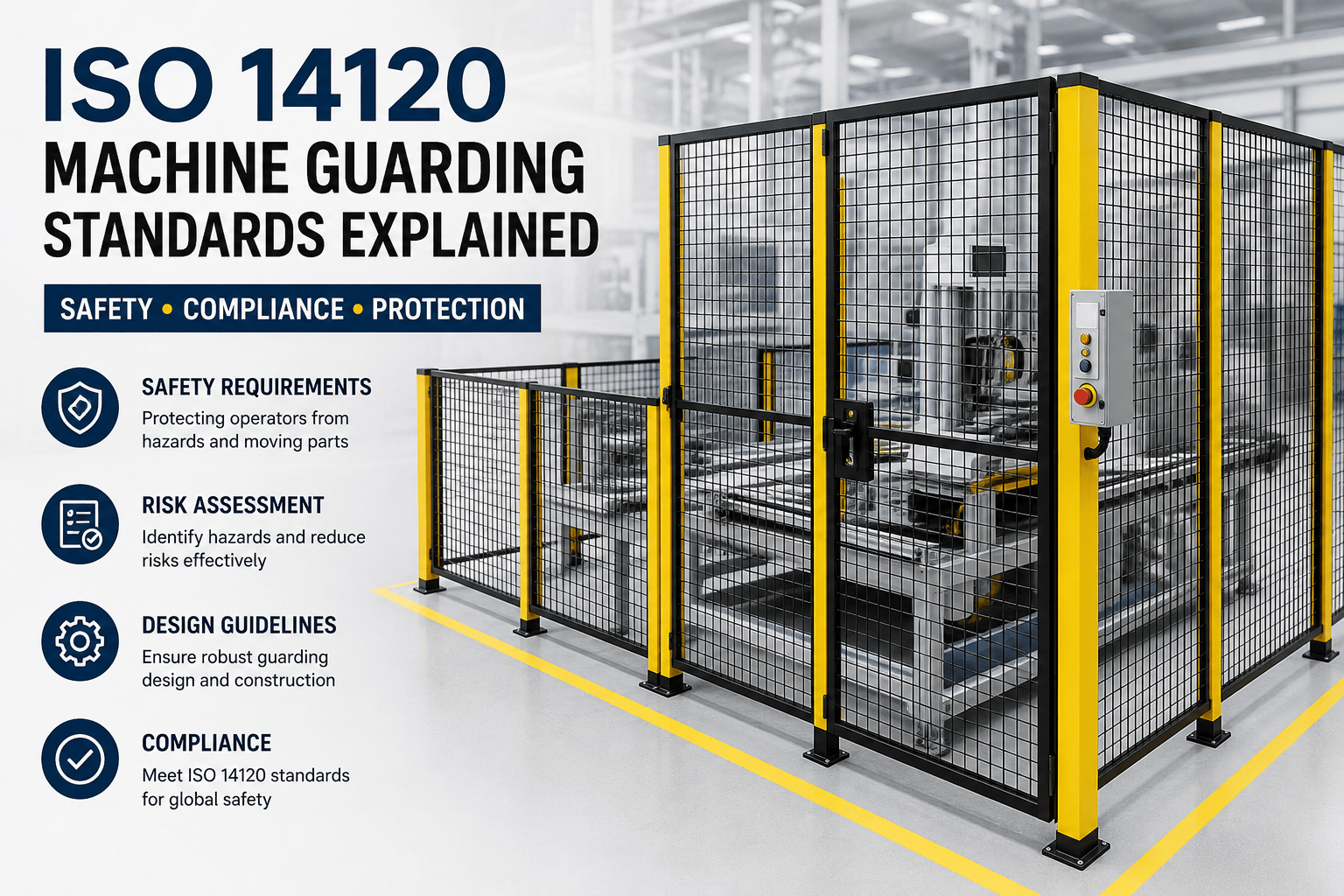
When a safety officer in Pune's Chakan MIDC specifies machine guarding for a new stamping press line, or when an automotive OEM auditor walks a robot cell at a Ranjangaon tier-1 supplier, one standard sits at the technical foundation of every evaluation: ISO 14120. For manufacturers across India's MIDC industrial zones — and for machine guarding manufacturers like Devidatt Enterprises — understanding this standard is not optional. It is the difference between a guard that passes a factory inspection and one that creates compliance liability the moment an auditor arrives on the shop floor.
This article explains ISO 14120 in plain language: what it covers, what it requires of guard design and construction, how it interacts with Indian law and companion international standards, and how manufacturers across Pune's MIDC belt can use it as a practical engineering tool rather than an abstract compliance obligation.
What Is ISO 14120?
ISO 14120 is an international standard titled Safety of Machinery — Guards — General Requirements for the Design and Construction of Fixed and Movable Guards. Published by the International Organization for Standardization (ISO), it defines the design, construction, and material requirements that machine guards must meet to be considered technically sound and fit for purpose as safety devices.
In the ISO machinery safety standards hierarchy, ISO 14120 is a Type-B standard — also called a generic safety standard. This means it applies broadly across machinery categories rather than being specific to one type of machine. It works in conjunction with Type-A standards (foundational safety principles, such as ISO 12100 on risk assessment) and Type-C standards (machine-specific standards, such as ISO 10218 for industrial robots), providing the guard-specific engineering requirements that both categories of standard reference.
Key Scope of ISO 14120: The standard applies to fixed guards, movable guards, and adjustable guards used as protective devices on machinery. It covers both the guards themselves and the fastening systems, hinges, interlocks, and structural features that make them functional and durable as safety components.
How ISO 14120 Relates to Indian Law and Standards
Indian manufacturers sometimes ask whether ISO 14120 is legally binding in India or whether it is simply a European/international benchmark. The answer is more nuanced than a simple yes or no — and understanding this nuance is critical for MIDC-based factories navigating both domestic compliance and international supply chain requirements.
The Factories Act 1948 Connection
The Factories Act 1948, Section 21, mandates that every dangerous part of any machinery shall be securely fenced. The Act does not prescribe specific engineering parameters for that fencing — it sets the obligation, not the technical specification. The Occupational Safety, Health and Working Conditions Code (OSH Code) 2020, which progressively supersedes several legacy labour laws, similarly establishes the duty to guard without dictating the engineering detail.
This is where ISO 14120 — and its Indian equivalent adopted by the Bureau of Indian Standards — becomes practically binding. When a factory inspector, MIDC safety auditor, or OEM safety engineer needs to evaluate whether a guard is "securely fenced" in the meaning of the Act, ISO 14120 provides the only available engineering benchmark against which that assessment can be made objectively. A guard that meets ISO 14120 is defensible. A guard that does not meet it — regardless of how substantial it looks — is not.
BIS Adoption: IS/ISO 14120
The Bureau of Indian Standards (BIS) has adopted ISO 14120 as an Indian Standard under the designation IS/ISO 14120, making it an Indian National Standard in addition to an international one. Indian manufacturers designing or procuring machine guards should specify compliance with IS/ISO 14120 in their technical specifications and purchase orders — not simply refer to "ISO compliance" generically, which is too vague to be meaningful in a procurement or legal context.
OEM Audit Requirements in Chakan and Talegaon MIDC
For tier-1 and tier-2 suppliers to automotive OEMs with plants in Chakan, Talegaon, and Ranjangaon MIDC, ISO 14120 compliance is explicitly checked during supplier safety audits. OEMs including Tata Motors, Volkswagen Group India, and Mercedes-Benz India reference ISO 14120 in their supplier safety standards and audit checklists. A guard installation that cannot be demonstrated to meet ISO 14120 design requirements will typically result in a major non-conformance finding — a finding that can delay production approval for new model programmes.
The Three Categories of Guards Under ISO 14120
ISO 14120 organises machine guards into three primary categories, each with different design requirements, appropriate use cases, and interlock obligations. Understanding these categories is the first step in specifying the right guard type for each hazard zone in a factory.
1. Fixed Guards
Fixed guards are guards that can only be removed using tools — they are not intended to be opened or removed during normal machine operation or routine operator interaction. Under ISO 14120, a fixed guard must be designed so that it cannot be held in position without its fasteners. In other words, if the fastening system is removed, the guard must fall away or become visibly displaced — preventing the scenario where someone removes the fixings and then repositions the guard panel without fasteners, creating a false appearance of guarding with none of the actual protection.
Fixed guards are the preferred guard type under the standard's hierarchy of preference when access to the guarded zone is genuinely not required during normal production. For components like drive shafts, flywheel covers, transmission guards, and belt drive enclosures on machines where operators never need to reach into the hazard zone during normal operation, a fixed guard is both the most secure and the lowest-maintenance solution.
Devidatt Enterprises manufactures fixed guard panels for CNC machining centres, grinding machines, and conveyor drive systems across Pune MIDC. These panels are fabricated to ISO 14120 requirements, including appropriate material strength, maximum aperture dimensions, and fastener specifications.
2. Movable Guards
Movable guards are guards that can be opened or displaced without tools — they are designed to provide access to a hazard zone for legitimate operational purposes such as workpiece loading/unloading, tool changes, or maintenance tasks, while ensuring the hazard is controlled when access is not in progress. ISO 14120 specifies that movable guards must be associated with an interlocking device unless the guard is too heavy or slow to reach a hazard zone before the machine comes to rest.
This is the category where the standard has the greatest technical depth, and where non-compliance is most commonly found during factory inspections. ISO 14120 specifies two sub-categories of movable guard:
- Interlocking movable guards: Guards where opening the guard sends a signal to stop the machine. The machine cannot start while the guard is open. This is the baseline requirement for most movable guards on powered machinery.
- Interlocking movable guards with guard locking: Guards where the guard is physically locked closed until the machine has reached a safe state — typically defined as zero motion or de-energized. This is required where the machine's stopping time is long enough that the operator could reach the hazard zone before the machine stops after the guard opens. Robot cells almost universally require guard locking because a robot arm moving at full speed cannot stop instantaneously.
Common Non-Compliance Finding: A movable guard fitted with a simple mechanical latch — but no interlock switch connected to the machine control system — is not compliant with ISO 14120. It provides physical access control but does not provide the interlocking function that the standard requires. This is one of the most frequently cited non-conformances in MIDC factory safety audits.
3. Adjustable Guards
Adjustable guards are fixed or movable guards that are adjustable as a whole or that incorporate adjustable parts. They are used where the nature of the operation requires the guard to be repositioned regularly — for example, a blade guard on a circular saw adjusted to accommodate different workpiece thicknesses. ISO 14120 requires that adjustable guards can be adjusted easily (to encourage proper use) but remain firmly in the adjusted position during operation without requiring continuous holding by the operator.
In MIDC manufacturing environments, adjustable guards are less common than fixed or interlocked movable guards, but they appear in general metalworking shops, woodworking operations, and packaging line equipment where operational flexibility genuinely requires guard adjustment between tasks.
Key Design Requirements Under ISO 14120
Beyond the three-category classification, ISO 14120 sets out specific engineering requirements that govern how guards must be designed and constructed. These requirements apply regardless of whether the guard is fabricated from mild steel, stainless steel, polycarbonate, or any other material.
Structural Strength and Rigidity
ISO 14120 requires that guards be designed to withstand the forces they will be exposed to in service — including deliberate human contact, the reaction forces from guarded machinery, and impact from flying parts or ejected workpieces. The standard does not prescribe specific wall thicknesses universally, because the required strength depends on the specific hazard being guarded. Instead, it requires the guard designer to consider the loads the guard will experience and specify materials and section sizes accordingly.
For the mild steel frame systems manufactured by Devidatt Enterprises, the standard's strength requirements translate to minimum frame tube wall thicknesses of 2mm to 3mm for standard machine perimeter guarding, with 3mm to 4mm sections specified for heavy-duty robot cell applications where robot collision forces must be absorbed by the perimeter fence without structural failure that could allow personnel access to the hazard zone.
Aperture Dimensions: The Safe Distance Principle
One of the most precisely specified requirements in ISO 14120 — working in conjunction with EN ISO 13857 (Safety Distances) — is the relationship between aperture size in the guard infill and the minimum distance from that aperture to the nearest hazard. This is the foundational principle behind the mesh specifications used in machine safety fencing.
The logic is straightforward: a person standing outside a guard can reach through an opening in the guard panel toward the hazard inside. The question ISO 14120 and EN ISO 13857 address is: what is the smallest aperture through which a hand, finger, or arm can pass, and how far can that limb reach through an aperture of a given size? The guard must maintain sufficient distance between its aperture and the nearest hazard so that even if a finger, hand, or arm passes through the opening, it cannot reach the hazard.
| Guard Aperture (Square / Slot Opening) | Minimum Distance from Aperture to Hazard Zone | Body Part That Can Pass Through |
|---|---|---|
| Up to 4mm | 2mm (fingertip only, cannot reach further) | Fingertip |
| 4mm – 8mm | 10mm | Finger to first joint |
| 8mm – 25mm | 120mm | Whole finger |
| 25mm – 40mm | 200mm | Finger plus knuckles |
| 40mm – 120mm | 850mm | Hand and part of arm |
| Over 120mm | Full body reach (requires total barrier approach) | Arm to shoulder or whole body |
This table explains why the standard 50mm × 50mm weld mesh used in Devidatt Enterprises' machine safety fencing panels requires that the panel surface be positioned at a minimum safe distance from the nearest hazard inside the guard — not simply placed immediately adjacent to the machine. A 50mm aperture falls in the 40mm–120mm range above, requiring the guard surface to be at least 850mm from the nearest moving part. In practice, this distance requirement is one of the primary factors that determines the standoff distance of the perimeter fence from the guarded machine, a consideration built into every site survey and design drawing we produce for MIDC clients.
Material Requirements
ISO 14120 does not mandate a specific material for guards, but it requires that the material chosen is appropriate for the hazard environment. Key material considerations specified or implied by the standard include:
- Resistance to the forces likely to be encountered, including impact from ejected parts, tool breakage fragments, or coolant pressure. Mild steel framed weld mesh panels are the default for most MIDC applications. Polycarbonate infill is acceptable where transparency is required, provided the polycarbonate grade selected has sufficient impact resistance for the specific application.
- Resistance to environmental degradation in the operating environment. A guard panel that corrodes within three years from coolant exposure does not maintain the structural properties required by the standard throughout its service life. This is why Devidatt Enterprises applies powder coat finish as standard and recommends hot-dip galvanizing for environments with heavy coolant exposure or outdoor installation.
- No creation of additional hazards. Guard materials must not introduce hazards themselves — for example, through sharp edges on mesh cutoffs, splinters, or toxic outgassing. All Devidatt mesh panels are edge-finished and all cut mesh ends are enclosed within the frame profile to eliminate exposed wire ends that would constitute a laceration hazard under the standard.
Fastening and Hinging Requirements
ISO 14120 places specific requirements on how guards are attached to machines or to supporting structures. For fixed guards, the standard requires captive fasteners where practicable — fasteners that remain attached to the guard even when removed, so they cannot be lost and are always available when the guard is reinstalled. The standard also requires that the fastening system is robust enough that the guard cannot be displaced by accident or by forces encountered in normal operation without deliberate removal of the fasteners.
For movable guards, hinges and pivot mechanisms must be designed so that the guard cannot be lifted off its hinges easily from the outside, as this would defeat the purpose of the interlock. The guard must also be designed so that it closes under gravity or spring force — a guard that stays open when released is non-compliant because an operator might prop it open and forget to close it before starting the machine.
ISO 14120 and Companion Standards: The Full Compliance Picture
ISO 14120 does not stand alone. Achieving genuine machine guarding compliance requires understanding how it works with several companion standards that address adjacent aspects of the machine safety system.
| Standard | Title / Subject | Relationship to ISO 14120 |
|---|---|---|
| ISO 12100 | Safety of Machinery — Risk Assessment and Risk Reduction | The parent framework. Risk assessment under ISO 12100 determines which guards are needed and what performance level they must achieve. ISO 14120 then specifies how to design those guards. |
| EN ISO 13857 | Safety Distances to Prevent Hazard Zones Being Reached | Provides the safe distance tables that determine the required standoff between guard apertures and hazard zones — directly applied alongside ISO 14120 aperture requirements. |
| ISO 14119 | Interlocking Devices Associated with Guards — Design Principles | Specifies how safety interlock switches on movable guards must be designed, selected, and installed. ISO 14120 requires interlocks; ISO 14119 tells you what those interlocks must do. |
| ISO 13849 | Safety of Machinery — Safety-Related Parts of Control Systems | Defines the Performance Level (PL) requirements for the control circuit connected to guard interlocks. A PL-d or PL-e safety relay circuit may be required depending on the risk assessment outcome. |
| ISO 10218 | Robots and Robotic Devices — Safety Requirements for Industrial Robots | The machine-specific (Type-C) standard for robot installations. References ISO 14120 for the guarding of robot cells and adds robot-specific requirements for teach pendant access, maximum guard opening dimensions, and stopping performance. |
| IS/ISO 14120 (BIS) | Indian National Standard adoption of ISO 14120 | The Indian Standard designation for the same document. Specifying IS/ISO 14120 in Indian procurement documents ensures the standard is referenced in a form recognised by Indian factory inspectors and BIS auditors. |
ISO 14120 in Practice: What It Means for Your MIDC Factory
Understanding the standard in theory is valuable. Applying it in a 24,000 square metre CNC machining facility in Bhosari MIDC with 40 machines of varying types, footprints, and hazard levels is where theory meets the practical realities of Indian manufacturing. Here is how ISO 14120 translates into the decisions a plant manager or safety officer faces on the ground.
Step 1: Risk Assessment First, Guard Specification Second
ISO 14120 is applied after — not instead of — a risk assessment under ISO 12100. The risk assessment identifies which machine hazards exist, which personnel are exposed, and how severe the potential harm is. This determines the required guard type (fixed, interlocked movable, or guard-locking movable) and the required safety integrity level for any interlock circuit. Attempting to specify guards without a risk assessment leads to either over-engineering (expensive) or under-specification (non-compliant and dangerous).
Step 2: Aperture-to-Hazard Distance Must Be Calculated, Not Estimated
The most technically consequential requirement of ISO 14120 — in conjunction with EN ISO 13857 — is the minimum distance from the guard panel surface to the nearest hazard inside the guarded zone. This distance depends on the mesh aperture size and cannot be estimated by eye. For a 50mm × 50mm weld mesh infill panel, the minimum standoff from the nearest moving part is 850mm based on the EN ISO 13857 tables. This calculation must be documented as part of the machine guarding design record.
Step 3: Interlock Specification Must Match the Risk Level
Not all interlock switches are equal under ISO 14119 and ISO 13849. A simple mechanical tongue-and-cam safety switch suitable for a low-risk application may be insufficient for a high-inertia robot cell where the risk assessment under ISO 12100 concludes that a Performance Level d (PLd) safety circuit is required. The interlock type must be matched to the risk level — and the safety circuit connecting it to the machine control must achieve the required performance level through appropriate component selection and circuit architecture (single-channel vs. dual-channel redundant).
Step 4: Documentation Is Part of Compliance
ISO 14120 compliance is not demonstrated simply by installing a guard — it must be documented. For OEM audits, factory inspections, and insurance assessments, the compliance record should include: the risk assessment that determined the guard requirements, the guard design drawings showing aperture dimensions and standoff distances, the material and surface treatment specifications, the interlock switch data sheets and safety circuit architecture diagrams, and the commissioning record confirming that interlocks were tested and found functional at installation. Devidatt Enterprises provides this complete documentation package with every industrial machine safety fencing installation.
How Devidatt Enterprises Designs to ISO 14120
Every machine safety fencing system manufactured by Devidatt Enterprises is designed with ISO 14120 / IS ISO 14120 as the governing engineering standard. Our design process incorporates the following ISO 14120-aligned practices as standard procedure across all MIDC client projects:
- Site-specific standoff calculations: We calculate and document the required guard-to-hazard standoff distance for every machine based on the specified mesh aperture and EN ISO 13857 safe distance tables, ensuring the perimeter fence positioning is not arbitrary but technically justified.
- Captive fastener specification: All fixed guard panels use M8 captive bolt fixings that remain attached to the panel frame when loosened, complying with the ISO 14120 requirement for fasteners that cannot be misplaced.
- Gravity-close door design: All movable access doors are designed with self-closing hinges that return the door to the closed position when released, preventing the non-compliant scenario of a guard that can be propped open inadvertently.
- Edge finishing of all mesh panels: All weld mesh infill panels have mesh ends enclosed within the frame profile, eliminating exposed wire ends and complying with the ISO 14120 requirement that guards shall not introduce additional hazards.
- Material certification: Steel sections are procured from BIS-certified suppliers with material test certificates (MTCs), providing traceability of material properties for compliance documentation purposes.
- Integration-ready interlock mounting: Access doors are supplied with pre-drilled and tapped mounting provisions for safety interlock switches, designed to accommodate the switch types required for the risk level of the specific application — from basic mechanical switches to coded magnetic switches for high-risk robot cell applications.
For robot cell applications specifically, our robot safety fencing systems are designed in conjunction with the robot cell integrator's safety plan, referencing both ISO 14120 and ISO 10218-2 requirements for robot guarding to ensure the complete cell meets the composite standard requirements.
Need ISO 14120-Compliant Machine Guards for Your MIDC Facility?
Devidatt Enterprises designs, manufactures, and installs machine guarding systems built to IS/ISO 14120 with full compliance documentation. Serving Chakan, Bhosari, Ranjangaon, Talegaon, and all Pune MIDC zones.
Phone: +91 8975383232
Email: info@devidattenterprises.com
Website: www.devidattenterprises.com
Manufacturing Facility: H.No. 40/3 Pathar Bhag, Dhankawadi, Pune, Maharashtra 411046
Frequently Asked Questions: ISO 14120 Machine Guarding Standard
1. What does ISO 14120 cover and what does it not cover?
ISO 14120 covers the design and construction requirements for fixed guards, movable guards, and adjustable guards used as safety devices on machinery. It covers structural strength, aperture dimensions, material requirements, fastening systems, and hinging/interlock provisions. It does not cover: the selection of which guard type to use (that is addressed by ISO 12100 risk assessment), the safety circuit performance requirements for interlock systems (addressed by ISO 13849), the specific design of interlock devices (addressed by ISO 14119), or the safe distances used to position guards relative to hazards (addressed by EN ISO 13857). All of these companion standards must be applied alongside ISO 14120 for a complete and compliant machine guarding solution.
2. Is ISO 14120 mandatory in India or is it voluntary?
ISO 14120 has been adopted by the Bureau of Indian Standards as IS/ISO 14120, making it an Indian National Standard. While the standard itself is not directly cited in the text of the Factories Act 1948, it is the established engineering benchmark against which "secure fencing" under Section 21 of the Act is evaluated by factory inspectors, MIDC safety auditors, and OEM supplier safety assessors. In practice, for any manufacturer subject to factory inspection or OEM audit requirements — which includes the overwhelming majority of MIDC manufacturing units — compliance with IS/ISO 14120 is effectively mandatory. Non-compliant guards will be cited as deficiencies in factory inspections and will result in major non-conformance findings in automotive OEM safety audits.
3. What is the difference between a fixed guard and an interlocking guard under ISO 14120?
A fixed guard is one that can only be removed using a tool (spanner, screwdriver, etc.) and is not intended to be opened during normal machine operation. An interlocking guard (a category of movable guard) is one that can be opened without tools for operational access, but sends a signal to halt machine motion when opened — and cannot allow machine restart while it is open. ISO 14120 sets a hierarchy preference for fixed guards over movable guards where access is genuinely not required during normal operation. Where access is operationally necessary, a movable interlocking guard is required rather than a fixed guard.
4. What mesh size is allowed on machine guarding panels under ISO 14120 / EN ISO 13857?
ISO 14120 does not prescribe a single allowable mesh size. Instead, it requires that the guard aperture size be matched to a minimum distance from the aperture to the nearest hazard, as determined by the safe distance tables in EN ISO 13857. The most common specification used in Indian MIDC machine guarding — 50mm × 50mm weld mesh — requires that the guard panel be positioned at least 850mm from the nearest moving part or energy source inside the guarded zone. Smaller mesh sizes (e.g., 25mm × 25mm) allow the guard to be positioned closer to the hazard. Larger apertures require greater standoff distances and may not be appropriate for all applications.
5. Does ISO 14120 apply to robot safety fencing?
Yes. ISO 14120 applies to the guards and perimeter fencing used in robot cell installations. However, robot cell guarding must also comply with ISO 10218-2 (Safety Requirements for Robot Systems and Integration), which adds robot-specific requirements including the maximum dimension of openings in the safeguarding, requirements for teach pendant access, material entry/exit safeguarding, and integration with the robot controller's safety I/O system. For robot cells, both ISO 14120 and ISO 10218-2 apply simultaneously, and guard design must satisfy both standards. Our dedicated robot cell safety fencing systems are designed to meet both standards as standard practice.
6. How do I know if my existing machine guards are ISO 14120 compliant?
Evaluating existing guards against ISO 14120 requires checking the following key criteria: Are fixed guards retained by captive fasteners that require a tool to remove? Are movable guards fitted with functional interlock switches (not just latches) connected to the machine control circuit? Do apertures in the guard infill comply with the safe distance requirements in EN ISO 13857 given the actual standoff distance from the nearest hazard? Is the guard material sufficiently strong to withstand the forces of the specific hazard environment? Is there documentation confirming these parameters were evaluated at design stage? If any of these criteria cannot be confirmed, a formal compliance review by a qualified safety engineer is recommended. Devidatt Enterprises offers site survey assessments for MIDC clients seeking to evaluate their existing machine guarding against IS/ISO 14120 requirements.
7. What is the relationship between ISO 14120 and Performance Level (PL) requirements?
ISO 14120 specifies the physical design and construction of guards, but does not itself define Performance Level requirements for safety circuits. The Performance Level (PL) framework — defined in ISO 13849 — applies to the safety-related control circuit that connects a movable guard's interlock switch to the machine's safety function (e.g., the circuit that stops the machine when a guard is opened). The required PL is determined by the risk assessment under ISO 12100. ISO 14120 requires that a movable guard have an interlocking function; ISO 13849 determines how reliable and fault-tolerant that interlocking function's control circuit must be. For high-risk applications such as robot cells, a PLd or PLe safety relay or safety PLC circuit is typically required, implementing dual-channel monitoring with cross-fault detection.
This article provides an educational overview of ISO 14120 for the benefit of safety professionals, plant managers, and procurement engineers working in Indian manufacturing. It does not constitute legal or engineering advice. Specific machine guarding design must be undertaken by a qualified machinery safety engineer applying the full suite of applicable standards to a specific machine risk assessment. For compliance-critical applications, always engage a certified functional safety engineer.
*Standard details referenced in this article are based on ISO 14120 and companion standards as published and adopted by BIS. Always verify current standard revisions through the ISO or BIS publication portals before applying to engineering design.