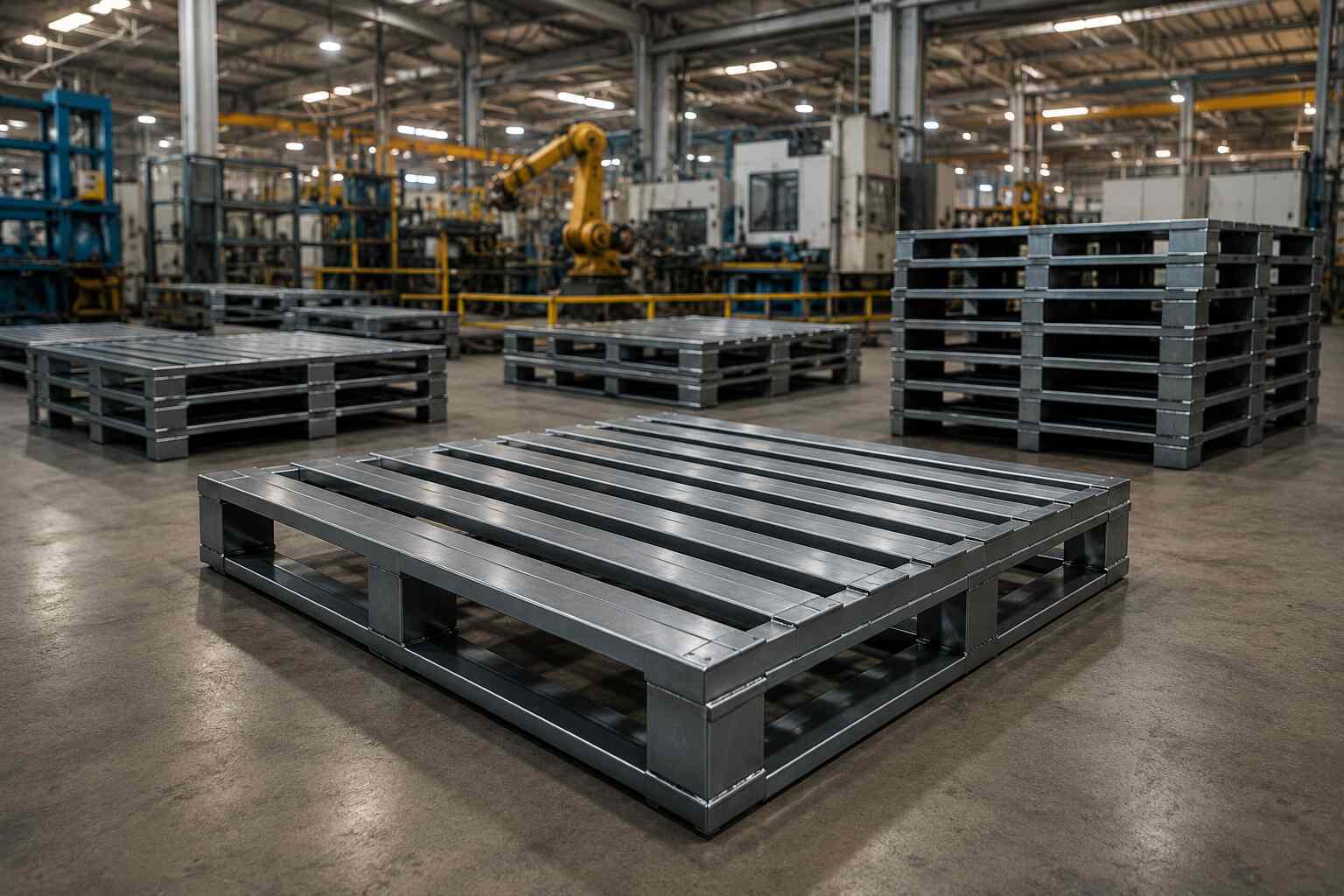
Walk into the dispatch yard or the raw material store of any manufacturing unit in Chakan MIDC, Bhosari MIDC, or Ranjangaon MIDC and the first thing you will notice stacked, wrapped, and waiting for a forklift is a pallet. In heavy engineering, automotive component manufacturing, and export-oriented units, wood pallets are steadily being replaced by a stronger, longer-lasting, and more compliance-friendly alternative: the industrial metal pallet. Unlike timber, a metal pallet does not splinter, does not require ISPM 15 fumigation certification for export shipments, and can be reused for years under repeated forklift handling, racking, and stacking loads without structural degradation. Industrial metal pallets have become the standard load-bearing platform for factories that move heavy, high-value, or export-bound material on a daily basis.
This guide covers everything a plant manager, warehouse in-charge, or procurement engineer in Pune's MIDC industrial belt needs to know before specifying and buying industrial metal pallets: the construction types available, how load capacity is actually calculated, the material and finish choices that determine service life, and the practical mistakes that lead to premature pallet failure, product damage, or a rejected consignment at the customer's dock. Whether you are equipping a new warehouse, replacing a fleet of damaged wood pallets, or specifying pallets for an export order, this article is the technical foundation for making that decision correctly.
Why Industrial Metal Pallets Outperform Wood and Plastic in an Indian Factory Environment
A pallet is not a passive piece of packaging it is a structural load-bearing platform that is picked up, dropped, stacked, and racked hundreds of times over its working life, often carrying loads several times its own weight. The choice of pallet material has a direct effect on product safety, storage density, and total cost of ownership, and the operating conditions typical of Indian manufacturing plants make the case for metal particularly strong.
Wood pallets are inexpensive up front but degrade quickly under Indian factory conditions: humidity and monsoon moisture cause swelling and fungal decay, repeated forklift impacts split the deck boards and stringers, and damaged nails and splinters create a genuine hand-injury hazard for warehouse staff handling the pallet manually. Wood pallets used in export consignments also require ISPM 15 heat treatment and fumigation certification (the stamped "IPPC" mark), which adds cost, lead time, and a compliance risk if the certification is missing or expired at the port. Plastic pallets solve the moisture and splinter problems but have a lower load capacity for their weight, are more expensive than wood, can become brittle under high heat near furnaces or ovens, and cannot be repaired once cracked they are simply scrapped.
Metal pallets fabricated from mild steel (MS) or galvanised iron (GI) address all three weaknesses simultaneously: they are immune to moisture damage and biological decay, they have no ISPM 15 requirement because there is no wood content, and a bent or damaged metal pallet can usually be straightened, re-welded, and returned to service rather than scrapped. The higher upfront cost of a metal pallet compared to wood is typically recovered within twelve to twenty-four months of continuous use through the elimination of repeat purchases, reduced product damage, and lower manual handling risk.
- Load consistency over time: A properly designed metal pallet does not lose load capacity through fatigue the way wood loses strength as boards crack and stringers split.
- Stacking and racking stability: Metal pallets hold their dimensional tolerance under repeated loading, which matters directly for safe high-rack warehouse storage where a pallet must sit square and flat on the rack beam.
- Hygiene and contamination control: For pharmaceutical, food-adjacent, and precision component storage, a metal pallet can be degreased, washed, and kept free of the mould and pest contamination risk associated with untreated wood.
- Fire and spark resistance: In foundries, welding shops, and areas near hot processes, a non-combustible metal pallet removes a fire load that a wood pallet would otherwise introduce.
- Return logistics for export: Reusable steel pallets in a closed-loop supply chain avoid the recurring cost and paperwork of ISPM 15-certified wood pallets for every outbound shipment.
Types of Industrial Metal Pallets
Not every application needs the same pallet design. The correct type depends on how the pallet will be handled (forklift, pallet truck, or crane), how it will be stored (floor stacked or racked), and what it will carry (finished goods, raw stock, or in-process components). The following are the industrial metal pallet types most commonly specified for Indian manufacturing and warehousing operations.
Two-Way Entry Pallets
The forklift or pallet truck forks can only enter from two opposite sides. This is the simplest and most economical metal pallet construction, suitable for straightforward floor storage and dispatch operations where the pallet orientation in the yard is predictable and controlled.
Four-Way Entry Pallets
Forks can enter from all four sides, which significantly improves handling flexibility in a busy warehouse or dispatch yard where forklifts approach from different directions. Four-way entry is achieved either through a notched stringer design or a full perimeter base frame, and it is the preferred specification for high-turnover finished goods stores.
Stackable Metal Pallets
Designed with a solid or reinforced deck and a base frame profile that nests securely on top of the pallet below, allowing loaded pallets to be floor-stacked several units high without a rack structure. Stackable pallets are the standard choice for raw material yards and bulk component storage where rack infrastructure is not justified.
Nestable Metal Pallets
When empty, nestable pallets stack inside one another to a fraction of their loaded height, dramatically reducing the storage and return-transport footprint for empty pallets. This design is particularly valuable for automotive tier-1 and tier-2 suppliers running a closed-loop returnable packaging system with an OEM customer.
Post Pallets and Cage Pallets
Post pallets use removable or fixed corner posts to allow safe multi-tier stacking of loose or irregularly shaped components without crushing the load below. Cage pallets add mesh or bar sides around the post frame, which is essential for storing and transporting small, loose, or rolling components loose fasteners, castings, or small machined parts that would otherwise fall from an open deck.
Roll Pallets and Wheeled Metal Pallets
Fitted with heavy-duty castors instead of a fork-entry base, roll pallets are used for short-distance internal transport between production stages where a pallet truck is impractical, such as moving in-process assemblies between adjacent workstations on a shop floor.
Construction, Material, and Finish Specification
The structural integrity of an industrial metal pallet comes from three elements working together: the deck that carries the load, the base frame or runners that transfer the load to the floor or rack beam, and the corner and edge reinforcement that resists impact damage from forklift handling.
Deck Design
The deck is typically constructed from either a solid MS sheet (2mm to 3mm thickness for standard duty, up to 4mm for heavy-duty applications) or a bar-grating/perforated sheet deck that reduces weight and allows dust, coolant, or moisture to drain through rather than pool on the surface. Perforated decks are the preferred specification for pallets used in machining, casting, or washing operations where residual fluid on a solid deck would be a slip hazard and a corrosion risk.
Base Frame and Runners
The base frame is fabricated from MS channel or rectangular hollow section (RHS), typically 40mm × 40mm to 75mm × 40mm depending on load rating, welded into a rigid rectangular frame with intermediate cross-members positioned to match standard fork spacing and to prevent deck sag under point loading. For rack-stored pallets, the base frame height and clearance must be verified against the specific rack beam profile in use at the facility to ensure the pallet seats correctly and does not foul the beam.
Corner and Edge Protection
Corners are the most frequently damaged part of any pallet in daily forklift handling. Heavy-duty industrial metal pallets are specified with reinforced corner gussets or rolled edge profiles that absorb impact without transmitting stress into the main weld joints, extending the pallet's service life significantly compared to a plain square-cut corner.
Surface Finish
Finish selection depends on the storage and handling environment. Powder coating is the standard finish for indoor dispatch and warehouse use, providing a durable, easy-to-clean surface at moderate cost. Hot-dip galvanising is specified for outdoor yard storage, humid coastal-adjacent facilities, or any application with regular exposure to moisture, coolant, or washdown, since the zinc coating provides sacrificial corrosion protection that powder coating alone cannot match. For pallets used in direct contact with corrosive chemicals or in pharmaceutical clean environments, stainless steel (SS 304) construction may be specified, though at a substantially higher cost than MS or GI.
Load Capacity: How to Specify It Correctly
Load capacity is the single most misunderstood specification in industrial pallet procurement. A pallet has three distinct load ratings, and quoting only one of them without the others is the most common source of a pallet being used beyond its safe capacity in actual factory conditions.
| Load Rating Type | What It Measures | Why It Matters |
|---|---|---|
| Static Load Capacity | Maximum load the pallet can bear when supported on a flat, level floor with the full deck in contact with the ground | Relevant for floor-stored, single-tier pallets that are not stacked or racked |
| Dynamic Load Capacity | Maximum load the pallet can safely carry while being lifted and moved by a forklift or pallet truck | Always lower than static capacity because lifting introduces shock and uneven load distribution across the forks |
| Racking Load Capacity | Maximum load the pallet can carry when supported only at the two ends by rack beams, with the middle of the deck unsupported | The most demanding rating deck deflection under an unsupported middle span is the limiting factor for racked storage |
For most Indian factory applications, standard-duty industrial metal pallets sized 1200mm × 1000mm are specified with a static load capacity in the 1500kg to 2500kg range and a dynamic (in-motion) capacity of 1000kg to 1500kg. Heavy-duty pallets built with thicker deck material and reinforced base frames for engineering, casting, and automotive component storage are specified up to 3000kg to 5000kg static capacity. The racking load capacity should always be requested separately and verified against the actual rack beam spacing at the facility a pallet rated for 2000kg static floor load may deflect beyond an acceptable limit if racked across a wider-than-standard beam span.
Procurement Point for MIDC Buyers: Always request the static, dynamic, and racking load figures together, along with the deck material thickness and base frame section size used to achieve that rating. A quotation that states only "heavy duty" without numeric load figures and material specification cannot be verified and should not be accepted for any application involving racked storage or repeated forklift handling of high-value or heavy components.
Standard Sizes and Custom Fabrication
While industrial metal pallets can be fabricated to any dimension required by a specific application, a small number of standard footprints cover the large majority of Indian factory and warehousing needs, chosen to align with common rack bay widths, container floor dimensions, and truck body sizes.
| Standard Size | Common Application |
|---|---|
| 1200mm × 1000mm | General warehousing, export shipments, standard rack storage (ISO-aligned footprint) |
| 1200mm × 800mm | Euro-pallet-aligned footprint for European export consignments |
| 1100mm × 1100mm | Common in domestic engineering and auto-component storage across MIDC facilities |
| Custom sizes | Sized to specific component dimensions, container loading patterns, or existing rack bay widths |
Devidatt Enterprises fabricates industrial metal pallets in both standard footprints held as ready stock for fast dispatch and fully custom sizes engineered around a client's specific component geometry, rack infrastructure, or container loading plan.
Common Problems Found in MIDC Warehouses and Yards
Based on site visits and replacement orders across Pune MIDC manufacturing facilities, the following issues are the most frequently observed problems with industrial metal pallets already in service, most of which trace back to an under-specified pallet at the time of original purchase.
| Problem Observed | Root Cause | Consequence |
|---|---|---|
| Deck sagging or permanent bow under racked storage | Racking load capacity not verified against actual rack beam span at time of purchase | Unstable load, risk of pallet or product falling from rack height |
| Corrosion and rust perforation on outdoor-stored pallets | Powder-coated finish specified for a yard or outdoor application instead of hot-dip galvanising | Reduced structural section over time, eventual load failure |
| Cracked welds at corner and cross-member joints | Under-gauge frame section or insufficient weld penetration for the actual handling impact loads | Progressive structural failure, sudden collapse under load |
| Fork damage to base frame from repeated mishandling | No reinforced fork-entry guide or edge protection specified on the base frame | Bent runners, pallet no longer sits flat on floor or rack beam |
| No visible load rating marking on the pallet | Pallet supplied without a stamped or stencilled load capacity plate | Operators cannot verify safe working load, leading to accidental overloading |
| Mixed pallet fleet with inconsistent dimensions | Repeat orders placed with different suppliers without a fixed specification on file | Poor rack utilisation, unstable mixed stacking, dispatch inefficiency |
Need Industrial Metal Pallets for Your MIDC Facility?
Devidatt Enterprises designs, fabricates, and supplies industrial metal pallets built to your load, size, and finish specification with verified static, dynamic, and racking load ratings. Serving Chakan, Bhosari, Ranjangaon, Talegaon, and all Pune MIDC zones.
Phone: +91 8975383232
Email: info@devidattenterprises.com
Website: www.devidattenterprises.com
Manufacturing Facility: H.No. 40/3 Pathar Bhag, Dhankawadi, Pune, Maharashtra 411046
How Devidatt Enterprises Manufactures Industrial Metal Pallets
Every industrial metal pallet manufactured by Devidatt Enterprises is built around a documented load requirement rather than a generic off-the-shelf design. Our process for MIDC clients includes the following stages as standard practice.
Load and Application Assessment
Before fabrication, we confirm the actual load the pallet will carry (including any dynamic loading from forklift or crane handling), the storage method (floor stacked, racked, or in transit), the rack beam specification if applicable, and the environmental conditions the pallet will be exposed to indoor, outdoor, washdown, or chemical exposure.
Material and Section Selection
Deck thickness, base frame section size, and cross-member spacing are selected to deliver the required static, dynamic, and racking load ratings with an appropriate safety margin, not simply built to a standard catalogue size regardless of the actual duty.
Fabrication and Weld Quality
All frames are fabricated in our Pune manufacturing facility using full-penetration welds at load-bearing joints, with corner and cross-member connections designed to distribute impact loads rather than concentrate stress at a single point.
Finish Application
Powder coating is applied as standard for indoor use; hot-dip galvanising is available for outdoor, humid, or washdown environments; and stainless steel construction is offered for chemical or clean-environment applications.
Load Marking and Documentation
Every pallet leaving our facility is supplied with the static, dynamic, and racking load capacity clearly stencilled or plated on the frame, along with a specification sheet documenting the material, dimensions, and load ratings for the client's own record and safety audit purposes.
Frequently Asked Questions: Industrial Metal Pallets
1. What is the typical load capacity of an industrial metal pallet?
Standard-duty industrial metal pallets sized 1200mm × 1000mm typically carry a static load capacity of 1500kg to 2500kg and a dynamic (in-motion, forklift-handled) capacity of 1000kg to 1500kg. Heavy-duty pallets built with thicker deck material and reinforced base frames for engineering, casting, and automotive component storage are available up to 3000kg to 5000kg static capacity. The exact figure depends on the deck thickness, base frame section size, and whether the pallet will be racked or floor stacked, so the rating should always be confirmed against your specific load rather than assumed from a generic catalogue figure.
2. Are metal pallets better than wood pallets for export shipments?
Yes, in most cases. Wood pallets used for export require ISPM 15 heat treatment and fumigation certification, adding cost, lead time, and a compliance risk if the certification is missing at the destination port. Metal pallets have no wood content and therefore no ISPM 15 requirement, and they can be reused across multiple shipment cycles in a closed-loop returnable packaging arrangement, which further reduces long-term packaging cost for regular export shipments.
3. What is the difference between a stackable and a nestable metal pallet?
A stackable pallet is designed so that loaded pallets can be placed on top of one another for floor storage, with the base frame of the upper pallet seating securely on the deck of the pallet below. A nestable pallet is designed for empty pallets to stack inside one another, reducing the storage and return-transport footprint of the empty pallet fleet. Some pallet designs combine both features, but the two purposes solve different problems and should be specified based on whether your priority is loaded storage density or empty pallet return logistics.
4. Should I choose powder coating or hot-dip galvanising for my metal pallets?
Powder coating is suitable for indoor dispatch and warehouse use where the pallet is not regularly exposed to moisture, washdown, or outdoor weather. Hot-dip galvanising is recommended for outdoor yard storage, coastal-adjacent facilities, or any application with regular exposure to coolant, moisture, or washdown, because the zinc coating provides sacrificial corrosion protection that continues to protect the steel even if the surface is scratched, which powder coating cannot do once its film is breached.
5. How do I know if my existing metal pallets are safe to keep using?
Inspect for deck sagging or permanent bowing, cracked or separated welds at corner and cross-member joints, corrosion that has visibly reduced the section thickness of the frame, and bent runners or base frames that prevent the pallet from sitting flat. A pallet with no visible or legible load rating marking should also be treated with caution since operators have no way to verify the safe working load. Any pallet showing structural damage should be withdrawn from racked storage immediately, since a partial weld failure under a racking load is far more dangerous than the same damage on a floor-stored pallet.
6. Can industrial metal pallets be custom sized for my components?
Yes. While standard footprints such as 1200mm × 1000mm and 1200mm × 800mm cover most general warehousing and export needs, industrial metal pallets can be fabricated to any custom dimension required to match specific component geometry, existing rack bay widths, or container loading patterns. Custom sizing is common in automotive and engineering component storage where a pallet is designed around the footprint of a specific part or sub-assembly rather than a generic size.
7. What information should I provide when requesting a quotation for industrial metal pallets?
To receive an accurate quotation, provide the maximum load per pallet, whether the pallet will be floor stacked or racked (and the rack beam span if racked), the required footprint dimensions, the handling method (forklift, pallet truck, or crane), the storage environment (indoor, outdoor, or washdown), and the required quantity. Supplying this information upfront allows the deck thickness, base frame section, and finish to be correctly specified rather than defaulted to a generic standard-duty design that may be under-rated for your actual application.
This article provides an educational overview of industrial metal pallets for the benefit of plant managers, warehouse in-charges, and procurement engineers working in Indian manufacturing. It does not constitute engineering or structural advice. Load capacity requirements for a specific application should always be confirmed against the actual load, handling method, and rack infrastructure in use at your facility.
*Load capacity and specification ranges referenced in this article are indicative industry figures for standard MS/GI fabricated pallets and may vary by manufacturer and design. Always request written load capacity documentation for your specific order.