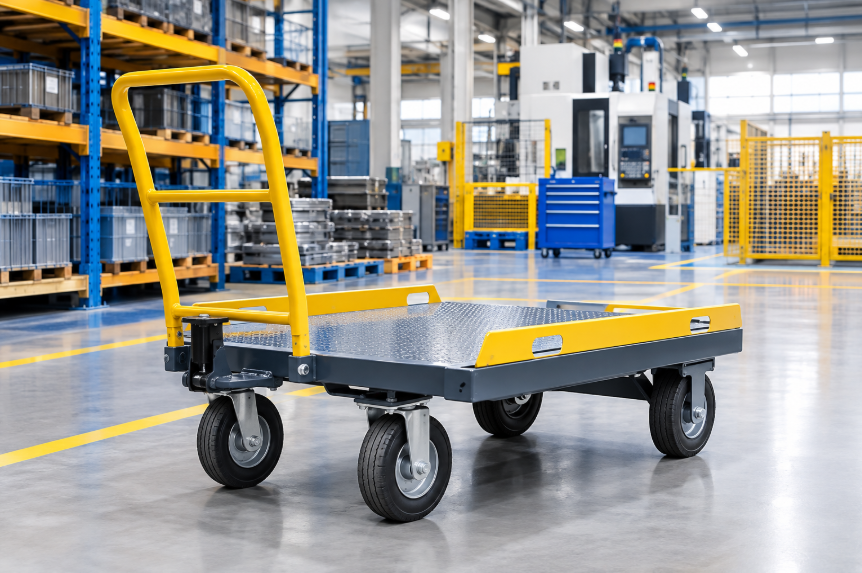
Step onto the shop floor of any auto-component plant in Chakan MIDC, an engineering unit in Bhosari MIDC, or a fabrication facility in Ranjangaon MIDC and you will immediately see that the most constant motion on that floor is not the machines it is the movement of material between them. Raw stock moves from the store to the cutting station. Sub-assemblies travel from fabrication to welding. Finished components shift from inspection to dispatch. Every one of those movements is a material handling event, and the equipment that makes that movement efficient, safe, and consistent is the industrial material handling trolley. Industrial material handling trolleys are the circulatory system of a manufacturing plant when they are well specified, the plant runs smoothly; when they are poorly chosen, the result is slow throughput, operator fatigue, product damage, and workplace injury.
This guide is written for plant managers, production engineers, and procurement teams across Pune's MIDC industrial belt who are either equipping a new facility, standardising an existing mixed fleet of trolleys, or replacing worn equipment. It covers the trolley types available for Indian manufacturing operations, how load capacity and wheel specification interact in a real factory environment, the material and finish choices that determine service life, and the specification errors that result in a trolley fleet that works against your production flow rather than with it. By the end of this article, you will have the technical foundation to specify an industrial material handling trolley correctly for your specific application rather than defaulting to a generic design that may be unsuited to your floor conditions, load type, or handling frequency.
Why the Right Industrial Material Handling Trolley Matters More Than It Seems
A trolley is often treated as a low-priority procurement something bought off the shelf at the lowest available price and replaced when it breaks. This approach is one of the most expensive mistakes a production facility can make. The cost of a poorly specified trolley is not the price of the trolley itself; it is the accumulated cost of the problems it creates over its working life: slow material movement between workstations, operator back and shoulder injuries from pushing an overloaded or mismatched trolley, product damage from an unstable load on a deck that does not suit the component geometry, and production delays caused by a trolley that is out of service awaiting repair.
In MIDC manufacturing plants, the material handling trolley is in continuous use across multiple shifts, covering tens or hundreds of metres of floor per trip, often over uneven concrete, workshop floor joints, or the lips of dock levellers. The loads carried range from a few kilograms of small components in a bin trolley to several hundred kilograms of raw bar stock or machined sub-assemblies on a flat-deck trolley. The environment ranges from clean, dry assembly areas to coolant-wet machining floors, outdoor raw material yards, and paint shop approaches where chemical exposure is a factor. Each of these conditions demands a different trolley specification and a single generic design selected without considering these factors will be either over-engineered and wasteful or under-engineered and dangerous.
- Operator safety and ergonomics: A correctly sized, correctly loaded, and correctly wheeled trolley can be moved by one operator without excessive force. An under-wheeled or overloaded trolley requires two operators or causes the kind of repetitive strain that results in long-term musculoskeletal injury claims under the Factories Act.
- Product integrity: A trolley with the right deck design and load restraint keeps components secure during transit between workstations. A flat sheet trolley used to carry loose small parts, or a wire mesh trolley used for large panels that flex and catch on the mesh, is a constant source of product damage that appears in the quality rejection data but is rarely traced back to the handling equipment.
- Throughput and flow: A trolley that is the right size for the load, the aisle width, and the workstation configuration enables one-piece flow and on-time internal supply. A trolley that is too large for the aisle, too small for the load, or the wrong height for the receiving workstation creates queuing, double-handling, and waiting all waste in the lean manufacturing sense.
- Maintenance and total cost: A well-specified trolley built from the correct material and fitted with the correct wheels for the floor type will give years of service without significant maintenance. A trolley with the wrong wheel type for a rough floor will have its castors replaced every few months, with the accumulated cost far exceeding the saving made on the original purchase price.
Types of Industrial Material Handling Trolleys
The industrial trolley market in India offers a wide range of designs, but most manufacturing applications are served by a handful of well-defined types. Choosing the right type is the first and most important specification decision, because a wrong type choice cannot be corrected by upgrading the material or the wheel specification.
Flat Deck Trolleys
The most versatile and widely used industrial trolley type, with a flat mild steel deck supported on a tubular or channel frame and fitted with four castors. Flat deck trolleys are used for moving box-packaged components, stacked trays, bins, and any load that has a flat base and does not require containment. The deck height is typically set at 750mm to 850mm to align with workstation surface heights for level transfer, reducing lifting. Deck thickness ranges from 2mm for light-duty applications to 4mm or more for heavy component loads.
Two-Tier and Multi-Tier Trolleys
Where floor space is limited and the load can be split across multiple levels, a two-tier or three-tier trolley doubles or triples the carrying capacity for the same floor footprint. These are standard in assembly areas where multiple part numbers are kitted and delivered to a workstation in a single trolley trip, and in dispatch areas where small finished goods are consolidated before packing.
Cage Trolleys and Box Trolleys
For loose components, small parts, or any load that requires containment to prevent items falling from the deck during transit, a cage trolley adds mesh or bar sides around the flat deck frame. Cage trolleys are the standard in fastener stores, casting and forging component transit, and any operation where the component is small enough to fall from an open deck. The cage can be fixed, folding for compact storage when empty, or removable to allow the trolley to serve both contained and open-deck roles.
Platform Trolleys
A low-profile flat deck trolley, typically 200mm to 400mm high, used for moving heavy, low-centre-of-gravity loads such as motor frames, heavy castings, or large fabricated sub-assemblies that would be unstable at standard workbench height. The low deck height also makes it easier to slide heavy items on and off without lifting. Platform trolleys intended for forklift interaction are often designed with fork pockets to allow the trolley to be picked up and repositioned without a separate pallet.
Hydraulic Scissor Lift Trolleys
A platform trolley with a built-in hydraulic or mechanical scissor lift mechanism that adjusts the deck height from floor level to working height, eliminating the need to lift heavy components manually for loading and unloading. Scissor lift trolleys are specified wherever ergonomic loading and unloading of heavy or awkward components is a priority, and wherever the receiving workstation height varies and a fixed-height trolley would require an additional lift step.
V-Frame and Saddle Trolleys
Designed specifically for transporting round bar stock, pipes, shafts, and cylindrical components that would roll off a flat deck. The V-profile or saddle profile of the deck locates the round stock securely and prevents movement during transit. V-frame trolleys are standard in machining shops, hydraulic cylinder manufacturing, and any facility that regularly moves cylindrical components between operations.
Weld Mesh Trolleys
A variant of the flat deck or cage trolley where the deck surface is fabricated from welded wire mesh rather than solid sheet steel. The open mesh deck allows coolant, swarf, and dust to fall through rather than accumulating on the surface, making these trolleys the preferred specification for machining and grinding operations where residual coolant on a solid deck would be a slip hazard and a corrosion accelerant for the components being moved.
Construction, Material, and Finish Specification
The structural integrity and service life of an industrial material handling trolley is determined by the interaction of three elements: the frame section and welding quality that carries the load, the deck material and profile that interfaces with the product, and the wheel and castor specification that determines how the load is transferred to the floor and how easily the trolley can be pushed by one operator.
Frame Construction
The frame of a well-built industrial trolley is fabricated from mild steel (MS) square hollow section (SHS) or rectangular hollow section (RHS), typically 25mm × 25mm to 50mm × 50mm for light to medium duty, and 50mm × 50mm to 75mm × 50mm or larger for heavy-duty applications. Channel and angle section frames are also used for heavy-duty platform trolleys where the open section provides better resistance to bending under a high point load. All load-bearing joints should be fully welded, not tack-welded, with particular attention to the junction between the castor bracket and the frame, which is the highest stress point under a rolling loaded trolley.
Deck Material and Thickness
The deck is typically fabricated from MS sheet (1.5mm to 4mm thickness depending on duty) or weld mesh. Solid MS decks are used where the surface must be flat and continuous for component stability. Weld mesh or chequered plate decks are used where drainage is required (machining and wet operations) or where operator grip on the deck surface during manual loading and unloading is a priority. Chequered plate (also called tread plate) is also specified where the trolley deck doubles as an ergonomic step or standing surface for operators.
Castor and Wheel Specification
The castor specification is one of the most consequential decisions in trolley design and one of the most frequently under-specified elements in budget trolleys bought without proper engineering consideration. The wrong wheel type for the floor surface and load is the most common cause of premature castor failure, difficult pushing, and floor damage in Indian factory environments.
| Wheel Type | Best For | Not Suitable For |
|---|---|---|
| Polyurethane (PU) | Smooth concrete and epoxy-coated floors, clean assembly areas, precision component transit low rolling resistance and no floor marking | Rough or uneven concrete, outdoor use, floors with metal swarf or abrasive debris that embeds in the soft wheel |
| Rubber | General factory floors, moderate loads, areas where noise reduction and floor protection are priorities | Chemical environments (oil and solvent exposure degrades rubber), very heavy loads where rubber deflects and increases rolling resistance |
| Nylon | Heavy loads on smooth, clean floors highest load rating for a given wheel diameter, suitable for heavy engineering and casting component transit | Rough floors (hard wheel transmits all vibration to the load), temperature-sensitive or fragile components (vibration causes damage or loosening) |
| Cast Iron | Foundry and heat-treatment environments, very heavy loads, rough industrial floors where other materials fail thermally stable | Smooth or coated floors (causes surface damage), precision component transit (severe vibration transmission) |
| Pneumatic (Inflated) | Outdoor yards, rough or uneven ground, dock leveller lips, and anywhere the trolley must be pushed over significant floor irregularities | Continuous indoor use with heavy loads (puncture risk, variable rolling resistance as pressure changes) |
Castors are also specified as either swivel (360-degree rotation) or fixed (directional only), and most industrial trolleys use a combination of two swivel castors at one end for steering and two fixed or brake castors at the other for directional stability. Brake castors swivel castors with a foot-operated locking mechanism are specified wherever the trolley must be held stationary at a workstation to prevent drift, particularly on any floor with a gradient and in loading dock environments.
Surface Finish
Powder coating is the standard finish for indoor factory trolleys used in dry or lightly humid environments, providing a durable, easy-to-clean surface at an economical cost. For trolleys used in machining areas where coolant contact is regular, or in outdoor material yards where weather exposure is unavoidable, epoxy primer followed by polyurethane topcoat or hot-dip galvanising of the frame before paint application provides significantly better long-term corrosion resistance. Stainless steel (SS 304) construction is specified for pharmaceutical, food-adjacent, or chemical environments where regular washdown with aggressive cleaning agents is required and carbon steel corrosion would contaminate the product or the environment.
Load Capacity: How to Specify It Correctly
Load capacity for an industrial trolley is a more nuanced figure than it first appears, and specifying only a maximum load weight without reference to load distribution, floor conditions, and castor rating is a common procurement error that leads to premature trolley failure or operator safety incidents.
| Specification Parameter | What It Covers | Why It Matters for Your Application |
|---|---|---|
| Rated Load Capacity (kg) | Maximum load the trolley frame is designed to carry, distributed across the deck | Must be verified against your heaviest loaded trip, not your average load the trolley must be rated for the worst case |
| Castor Load Rating (kg per castor) | Maximum load each individual castor is rated to carry under rolling conditions | Total castor rating (sum of all four castors) should exceed the trolley's rated load by at least 25% to account for uneven load distribution and dynamic shock loading during transit |
| Point Load vs Distributed Load | Whether the load sits centrally on the deck or is concentrated at a single point a single heavy casting sitting on a small contact area loads the deck differently from a uniformly distributed box load | Deck thickness and cross-member spacing must be specified to prevent deck deflection under the actual point load geometry, not just the total weight |
| Pushing Force (Newton) | The force required for one operator to start and maintain movement of the loaded trolley on the floor type in use | A trolley that requires more than approximately 200N to start moving is effectively a two-person operation, which has direct implications for ergonomic compliance and throughput |
Procurement Point for MIDC Buyers: Always request the frame load rating, the individual castor load rating, and the total castor load capacity together. A trolley quoted as "500kg capacity" with castors rated at only 100kg each (400kg total) is already under-specified at its stated capacity. The castor rating must exceed the frame rating, not merely equal it, to provide a safe margin under real-world uneven loading and floor irregularity conditions.
Standard Sizes and Custom Fabrication
While custom trolley dimensions are common in component-specific applications, a set of standard deck sizes covers the majority of general factory and warehouse use cases and can be held as ready stock for fast dispatch.
| Standard Deck Size | Common Application |
|---|---|
| 600mm × 900mm | Light-duty component transit, small assembly area supply, tool and consumable distribution |
| 750mm × 1200mm | General-purpose factory trolley, bin and tray transport, standard MIDC shop floor use |
| 900mm × 1500mm | Medium-duty component and sub-assembly transit, stores-to-production supply |
| 1000mm × 2000mm | Heavy-duty platform trolley, large fabricated components, long bar stock or pipe transport |
| Custom sizes | Sized to component geometry, aisle width constraints, workstation interface height, or OEM customer returnable packaging specifications |
Devidatt Enterprises fabricates industrial material handling trolleys in both standard sizes held as ready stock and fully custom configurations engineered around a client's component dimensions, aisle layout, workstation interface requirements, or returnable packaging specification for OEM supply.
Common Problems Found in MIDC Shop Floors
Based on site visits and replacement orders across Pune MIDC manufacturing facilities, the following problems are the most frequently observed issues with industrial trolleys already in service, most of which trace directly to an under-specified or incorrectly specified trolley at the time of original purchase.
| Problem Observed | Root Cause | Consequence |
|---|---|---|
| Castor failure within weeks of deployment | Wrong wheel material for the floor type, or castor load rating below total trolley load | Trolley out of service, castor replacement cost, production delay |
| Frame weld cracks at castor bracket junction | Tack-welded or under-gauge castor bracket fabrication, insufficient weld penetration at the highest-stress joint on the trolley | Progressive structural failure, sudden castor detachment under load serious operator safety risk |
| Deck deflection under point-loaded heavy castings | Deck sheet thickness specified for distributed load, not point load from a small-contact-area component | Permanent deck deformation, load instability, product damage |
| Corrosion perforation of frame in machining area | Standard powder-coat finish applied to a trolley used in a coolant-wet environment without additional primer or galvanising | Structural section loss, contamination of coolant and components with rust, premature trolley scrapping |
| Excessive pushing force requiring two operators | Hard nylon or cast iron castors specified for a smooth floor application where polyurethane would give far lower rolling resistance | Two-person handling where one is sufficient, ergonomic injury risk, throughput reduction |
| No load rating marking on the trolley | Trolley supplied without a stencilled or plated safe working load marking | Operators cannot verify maximum load, systematic overloading becomes routine practice |
| Mixed fleet with incompatible deck heights | Trolleys of different heights purchased across multiple orders without a fixed height specification | Level transfer between trolley and workstation impossible, additional lifting steps required, ergonomic injury risk |
Need Industrial Material Handling Trolleys for Your MIDC Facility?
Devidatt Enterprises designs, fabricates, and supplies industrial material handling trolleys built to your load, size, floor condition, and finish specification. Serving Chakan, Bhosari, Ranjangaon, Talegaon, and all Pune MIDC zones.
Phone: +91 8975383232
Email: info@devidattenterprises.com
Website: www.devidattenterprises.com
Manufacturing Facility: H.No. 40/3 Pathar Bhag, Dhankawadi, Pune, Maharashtra 411046
How Devidatt Enterprises Manufactures Industrial Material Handling Trolleys
Every industrial material handling trolley manufactured by Devidatt Enterprises is built around a documented application requirement rather than a catalogue template. Our process for MIDC clients includes the following stages as standard practice.
Application and Flow Assessment
Before fabrication, we confirm the actual load the trolley will carry (including the heaviest trip in the production cycle), the floor type and condition at the facility, the aisle widths and turning radii the trolley must navigate, the workstation interface height the trolley deck must align with, and the environmental conditions the trolley will be exposed to dry, coolant-wet, outdoor, or chemical. This assessment determines the frame design, deck specification, and castor selection before a single piece of steel is cut.
Frame and Deck Engineering
Frame section size, deck thickness, and cross-member spacing are selected to carry the specified load with the appropriate safety factor under point-load conditions, not just averaged distributed load conditions. Castor bracket design and attachment welding are given particular attention as the highest-stress junction on any rolling trolley.
Castor Selection and Sourcing
We source castors matched to the floor type, load, and required rolling force from verified suppliers, with individual castor load ratings confirmed to exceed the trolley's total rated load divided by the number of castors, with the required safety margin built in.
Fabrication and Weld Quality
All load-bearing joints are fully penetration-welded in our Pune manufacturing facility, with castor bracket attachments welded on all contact faces rather than on accessible faces only. Frame squareness and deck flatness are checked before finishing to ensure all four castors maintain floor contact without rocking on assembly.
Finish Application
Powder coating is applied as standard for indoor dry-environment use; epoxy primer plus polyurethane topcoat is available for coolant or moisture-exposed environments; and stainless steel construction is offered for washdown or chemical-exposure applications.
Load Marking and Documentation
Every trolley leaving our facility is supplied with the rated load capacity clearly stencilled or plated on the frame, along with a specification sheet documenting the material, deck size, frame section, castor specification, and rated load for the client's own record, maintenance planning, and factory safety audit purposes.
Frequently Asked Questions: Industrial Material Handling Trolleys
1. What is the typical load capacity of an industrial material handling trolley?
Standard light-duty industrial material handling trolleys carry 200kg to 500kg. Medium-duty general factory trolleys are typically rated from 500kg to 800kg. Heavy-duty platform and engineering trolleys are available from 800kg to 2000kg and above, depending on frame section, deck thickness, and castor specification. The rated capacity must always be confirmed against your specific heaviest loaded trip, including any dynamic shock loading from rough floor transitions, rather than assumed from a generic catalogue figure.
2. What is the best wheel type for a factory floor trolley in a Pune MIDC plant?
For smooth concrete or epoxy-coated floors in clean assembly or finished goods areas, polyurethane (PU) castors give the best combination of low rolling resistance, floor protection, and load capacity. For machining areas with coolant and swarf, nylon or phenolic castors resist chemical degradation better than rubber or PU. For outdoor yards or rough concrete floors with significant joints and unevenness, pneumatic or large-diameter rubber castors significantly reduce the pushing force required and protect the load from vibration. The worst outcome is to use hard nylon castors on a rough concrete floor the operator will struggle to push even a lightly loaded trolley, and every floor irregularity will be transmitted directly to the load.
3. How do I decide between a flat deck trolley, a cage trolley, and a platform trolley?
Use a flat deck trolley when your load has a stable flat base and will not fall or roll from an open deck boxed components, trays, and palletised loads are typical examples. Use a cage trolley when the load is loose, small, or likely to shift during transit and needs containment loose fasteners, small castings, and loose sub-components are the most common applications. Use a platform trolley (low-profile, 200mm to 400mm high) when the load is heavy and low, has a low centre of gravity, or must be slid rather than lifted onto the deck heavy motor frames, large dies, and long fabricated components that are unstable at standard workbench height are typical platform trolley loads.
4. What deck height should I specify for a factory trolley?
Standard factory material handling trolley deck heights of 750mm to 850mm are chosen to align with the typical workbench and machine table height range for level transfer of components without manual lifting. If your receiving workstations are at a non-standard height, the trolley deck height should be matched to the workstation rather than defaulted to a catalogue figure. Consistent deck height across a fleet is as important as the absolute height a mixed fleet where some trolleys are 750mm and others 850mm means level transfer is only possible at some workstations, and the others require an additional lift step that introduces both ergonomic risk and a handling delay.
5. How do I know when a trolley is worn out and should be replaced rather than repaired?
A trolley has reached end of service life when the frame shows cracked welds at multiple joints, particularly at castor bracket junctions that cannot be reliably repaired without full re-fabrication; when the deck has permanent deflection that cannot be straightened without reintroducing stress concentrations; or when the frame section has lost visible cross-sectional area to corrosion beyond approximately 20% of its original thickness. A trolley that rocks on all four castors despite castor adjustment attempts has a twisted frame that will not be corrected by castor replacement and should be scrapped. Castor failure alone without frame or deck damage is a repair, not a replacement trigger.
6. Can trolleys be custom built for returnable packaging supply to an OEM?
Yes. Returnable packaging trolleys for OEM supply, where the trolley must meet the customer's dimensional specification, load the customer's specific component without damage, and operate within the customer's facility as well as your own, are a standard part of our MIDC client work. We fabricate trolleys to OEM-specified dimensions, deck profiles, and load ratings, and can supply with the customer's identification marking and colour code as required under their returnable packaging agreement.
7. What information should I provide when requesting a quotation for industrial material handling trolleys?
To receive an accurate quotation, provide the maximum load per trip, the deck size required (or the component dimensions if a custom fit is needed), the deck height, the floor type and surface condition, whether the trolley will be used indoors or outdoors, whether containment sides are required, the required quantity, and any special requirements such as brake castors, swivel lock, stainless steel construction, or OEM specification compliance. Supplying this information upfront allows the frame section, deck thickness, castor type, and finish to be correctly specified rather than defaulted to a generic design that may be unsuited to your actual operating conditions.
This article provides an educational overview of industrial material handling trolleys for the benefit of plant managers, production engineers, and procurement teams working in Indian manufacturing. It does not constitute engineering or ergonomic advice. Load capacity and castor selection for a specific application should always be confirmed against the actual load, floor condition, and operator pushing force requirements at your facility.
*Load capacity and specification ranges referenced in this article are indicative industry figures for standard MS-fabricated trolleys and may vary by manufacturer and design. Always request written load capacity documentation for your specific order.