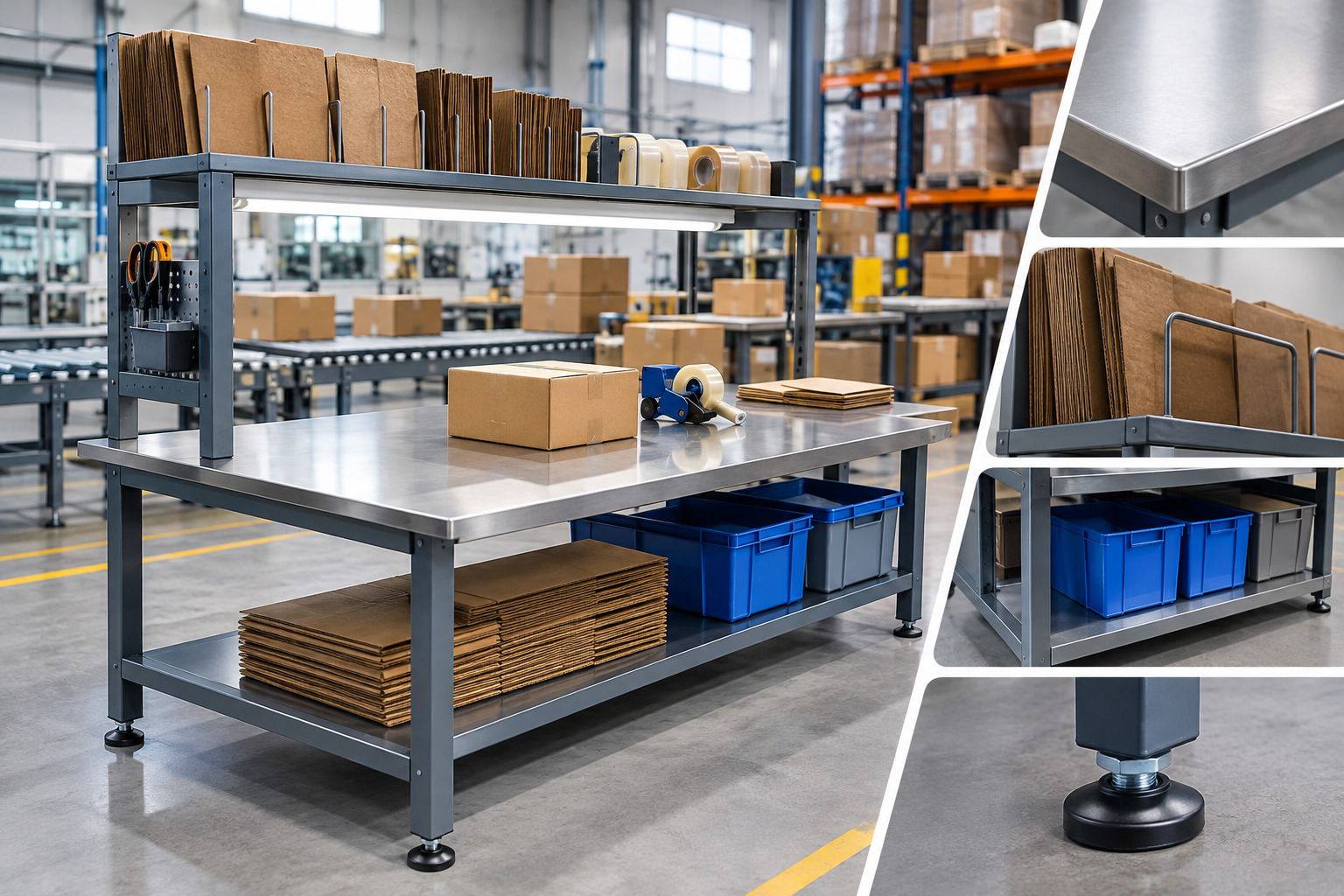
Every finished component has to pass through one last workstation before it leaves your plant: the packing station. Whether you run an auto-component unit in Chakan MIDC, an engineering facility in Bhosari MIDC, or a fabrication shop in Ranjangaon MIDC, the quality of that final stage decides whether parts reach the customer clean, counted, labelled, and undamaged. At the centre of that station is the industrial packing table. When it is well specified, packers work faster with less fatigue and fewer errors. When it is poorly chosen, the result is slow dispatch, wrong counts, damaged parts, and operator strain.
This guide is written for plant managers, dispatch heads, production engineers, and procurement teams across Pune's MIDC belt who are setting up a new packing line, standardising a mixed set of tables, or replacing worn equipment. It covers the types of industrial packing tables, the material and finish choices that decide service life, ergonomic height, load capacity, standard sizes, and the specification mistakes we most often see on shop floors. By the end, you will be able to brief an industrial packing table manufacturer with the right details instead of settling for a generic table that does not suit your product.
Why the Right Industrial Packing Table Matters
A packing table looks like the simplest item in a factory, so it is usually bought on price alone. The real cost shows up later: packers standing at the wrong height for eight hours, a wobbling top that makes weighing and labelling inaccurate, scratched finished parts, and tables that rust within a season because the wrong finish was used. A packing table is used continuously across shifts, so even small design flaws repeat hundreds of times a day.
- Operator ergonomics: A table at the wrong height forces the packer to bend or lift their shoulders. Over months this leads to back, neck, and shoulder complaints and higher absenteeism.
- Packing accuracy: A flat, rigid, stable top allows precise counting, weighing, and labelling. A flexing or uneven top introduces errors and rework.
- Product protection: The right top surface protects finished parts from scratches, dents, and contamination before they are boxed.
- Workflow and space: Integrated shelves, roller tracks, and tool holders keep cartons, tape, labels, and scanners within reach and reduce unnecessary movement.
- Total cost of ownership: A rigid, correctly finished table can serve for many years with minimal maintenance, while a cheap one is replaced repeatedly.
Types of Industrial Packing Tables
Most packing applications are served by a small number of well-defined designs. Choosing the right type comes first, because a wrong choice cannot be fixed later by upgrading the material.
Fixed Height MS Packing Tables
The standard workhorse: a mild steel (MS) frame with a sheet steel or laminated top, built at a fixed working height. These suit stable, repetitive packing stations where all operators are of similar height and the task does not change often.
Height Adjustable Packing Tables
Fitted with telescopic legs or adjustable foot assemblies, these tables let the height be set to suit different operators and different tasks. They are worth the extra cost in shared stations across shifts or where heavy and light products are packed at the same table.
Packing Tables with Overhead Shelf and Tool Rack
An overhead shelf or rack holds labels, tape dispensers, scanners, packing lists, and cartons within arm's reach. These are common in dispatch and e-commerce style order packing where cycle time matters.
Packing Tables with Roller or Conveyor Track
For heavier or longer components, a roller track along one or both sides lets the packer slide the product in and out of the packing zone without lifting. This reduces manual handling and speeds up flow into the carton or crate.
Mobile Packing Tables on Castors
A packing table on swivel and brake castors can be repositioned to follow the work, useful in small plants, multi-product dispatch areas, and temporary packing for urgent orders. Brake castors keep the table steady during use.
Stainless Steel and ESD Packing Tables
Stainless steel (SS 304) tables are chosen for pharmaceutical, food-adjacent, and washdown environments. ESD (electrostatic discharge) tables with a dissipative top and grounding point are used for electronic components and assemblies that can be damaged by static.
Construction, Material, and Finish Specification
The service life of an industrial packing table depends on three things working together: the frame that carries the load, the top surface that meets the product, and the finish that protects the steel.
Frame Construction
A well-built packing table frame is fabricated from MS square or rectangular hollow section, typically 40mm × 40mm for general packing and 50mm × 50mm or heavier where loads are high. Joints should be fully welded, with cross-bracing or a lower stretcher to prevent the table from racking sideways. Levelling feet compensate for uneven shop floors so the top remains flat.
Table Top Options
| Top Material | Best For | Points to Note |
|---|---|---|
| MS Sheet (2mm to 3mm) | General component packing, heavy items, rugged dispatch areas | Strong and economical; needs a coating to resist rust and can scratch soft finished parts |
| Laminated or Wooden Top | Light assemblies, delicate or painted parts, quiet packing stations | Gentle on products; not suited to wet or oily areas |
| Rubber or Foam Mat on Top | Polished, painted, or precision components that must not be scratched | Mat should be replaceable and kept free of swarf |
| Stainless Steel (SS 304) | Pharma, food-adjacent, chemical and washdown areas | Excellent hygiene and corrosion resistance at a higher cost |
| ESD Laminate or Mat | Electronic components, PCBs, sensitive assemblies | Needs a proper grounding connection to work as intended |
Surface Finish
Powder coating is the standard finish for indoor packing tables, giving a durable, easy-to-clean surface at an economical cost. For areas with oil, coolant, or humidity, an epoxy primer with a polyurethane topcoat gives better long-term protection. Where hygiene or washdown is required, stainless steel is the safer choice.
Ergonomics and Load Capacity: Specifying Them Correctly
Two specifications are most often left vague in purchase enquiries: the working height and the load capacity. Getting both right protects your people and your tables.
| Parameter | Typical Guidance | Why It Matters |
|---|---|---|
| Working Height | Commonly 800mm to 900mm for standing packing; lower for seated work or heavy items | The top should sit near elbow height so the packer works without bending or raising the shoulders |
| Table Depth | 600mm to 900mm depending on reach | Everything used frequently should be reachable without stretching |
| Distributed Load Capacity | Light duty 150kg to 300kg; heavy duty 500kg and above | Must be checked against the heaviest packed item plus cartons and tools placed on the table |
| Top Flatness and Rigidity | No visible deflection under working load | Supports accurate weighing, counting, and labelling |
| Edge Finish | Rounded or hemmed edges | Prevents cuts and snagging of gloves and cartons |
Procurement Point for MIDC Buyers: Do not buy a packing table based on length and price alone. Always confirm the working height for your operators, the heaviest item to be packed, the top material, and the finish for your floor environment. These four details prevent most of the problems we are asked to fix on replacement orders.
Standard Sizes and Custom Fabrication
A few standard sizes cover most general packing stations, while custom dimensions suit product-specific stations and tight layouts.
| Standard Table Size | Common Application |
|---|---|
| 900mm × 600mm | Single-operator packing of small parts, label and pouch packing |
| 1200mm × 600mm | General-purpose packing station for small to medium components |
| 1500mm × 750mm | Medium components, carton packing, kitting and weighing |
| 1800mm × 750mm | Larger sub-assemblies, two-operator stations, dispatch packing |
| 2400mm × 900mm | Long components, heavy-duty packing lines with roller track |
| Custom sizes | Built to component size, aisle width, line layout, or customer packing standard |
Devidatt Enterprises fabricates industrial packing tables in standard sizes and in fully custom configurations, with options such as overhead shelves, roller tracks, lower storage shelves, castors, ESD tops, and stainless steel construction.
Common Problems Found on MIDC Packing Stations
| Problem Observed | Root Cause | Consequence |
|---|---|---|
| Table wobbles or racks sideways | No cross-bracing, thin section, or uneven floor without levelling feet | Inaccurate weighing and labelling, operator frustration |
| Top sheet sags in the middle | Sheet too thin or cross-members spaced too far apart | Uneven surface, damaged parts, permanent deformation |
| Scratched finished components | Bare steel top used for polished or painted parts | Customer rejections and rework |
| Rust on frame and top within a season | Basic coating used in an oily, humid, or washdown area | Contamination of parts and early table replacement |
| Operator back and shoulder strain | Fixed height that does not suit the operators or the task | Fatigue, lower output, ergonomic injury risk |
| Static damage to electronic parts | Ordinary table used instead of an ESD-grounded one | Hidden failures that appear only at the customer end |
| Mixed table heights across a line | Tables bought in separate batches without a fixed height standard | Uneven workflow and inconsistent ergonomics |
Need Industrial Packing Tables for Your MIDC Facility?
Devidatt Enterprises designs, fabricates, and supplies industrial packing tables built to your size, height, load, and finish requirement. Serving Chakan, Bhosari, Ranjangaon, Talegaon, and all Pune MIDC zones.
Phone: +91 8975383232
Email: info@devidattenterprises.com
Website: www.devidattenterprises.com
Manufacturing Facility: H.No. 40/3 Pathar Bhag, Dhankawadi, Pune, Maharashtra 411046
How Devidatt Enterprises Manufactures Industrial Packing Tables
Every packing table we build starts from a documented requirement rather than a catalogue template. Our standard process for MIDC clients includes the following stages.
Application and Layout Assessment
We confirm the product size and weight, the packing method, operator height range, available floor space, and the environment (dry, oily, humid, washdown, or static-sensitive) before any steel is cut.
Frame and Top Engineering
Frame section, top thickness, and cross-member spacing are selected so the table stays flat and rigid under working load. Bracing and levelling feet are included as standard.
Fabrication and Weld Quality
All load-bearing joints are fully welded in our Pune facility. Edges are deburred and rounded, and squareness and top flatness are checked before finishing.
Finish and Accessories
Powder coating is standard for indoor dry use. Epoxy and polyurethane systems, stainless steel, ESD tops, rubber mats, overhead shelves, roller tracks, drawers, and castors are available to match your station.
Documentation and Delivery
Each order is supplied with a specification sheet covering size, material, top type, finish, and rated load for your records and factory audits, and delivered across Pune and nearby MIDC zones.
Frequently Asked Questions: Industrial Packing Tables
1. What is an industrial packing table?
An industrial packing table is a rigid, work-ready table used to count, inspect, label, and pack finished goods before dispatch. It is usually fabricated from mild steel or stainless steel with a flat top, and can include shelves, roller tracks, castors, or ESD protection depending on the application.
2. What is the best working height for a packing table?
For standing work, a height of roughly 800mm to 900mm suits most operators because the top sits near elbow level. Heavy items are often handled at a lower height, while seated packing needs a lower table again. If operators vary a lot in height, a height adjustable table is the better choice.
3. Which top material should I choose: MS, laminated, or stainless steel?
Choose an MS sheet top for rugged general packing, a laminated or mat-covered top for polished or painted parts that must not be scratched, and stainless steel for hygiene-sensitive or washdown areas. Electronic components need an ESD-grounded top.
4. What load capacity should a packing table have?
Light-duty tables typically handle around 150kg to 300kg, while heavy-duty tables are built for 500kg and above. Always size the table against the heaviest item you pack plus the cartons and tools that sit on the table at the same time.
5. Can packing tables be customised for my product and layout?
Yes. Size, height, top material, shelves, roller tracks, drawers, castors, and finish can all be customised to your component dimensions, aisle width, and line layout. Sharing your product size and packing method helps us recommend the right configuration.
6. How do I protect polished or painted parts on a packing table?
Use a soft top such as a laminated surface, a rubber or foam mat, or a protective covering over the steel top. Keep the surface clean and free of swarf, since trapped chips are a common cause of scratches.
7. What details should I share to get an accurate quotation?
Share the table size, working height, maximum load, top material, finish, operating environment, required accessories such as shelves or roller tracks, whether castors are needed, and the quantity. The more complete the brief, the more accurate the quotation and the better the table suits your station.
This article provides an educational overview of industrial packing tables for plant managers, production engineers, and procurement teams working in Indian manufacturing. It does not constitute engineering or ergonomic advice. Dimensions, height, and load capacity for a specific application should always be confirmed against your actual product, operators, and facility conditions.
*Specification ranges referenced in this article are indicative industry figures for standard fabricated packing tables and may vary by manufacturer and design. Always request written specification documentation for your specific order.